
Introducing 1costingFE
The open-source engine behind our numbers
1costingFE is an open-source framework that estimates the cost of fusion electricity. You give it a confinement concept, a fuel, and a design point; it returns a levelized cost of electricity, an account-by-account capital and operating breakdown, and the closed power balance behind them. It is calibrated and traceable through the account justification documents: one document per cost account, recording what the number is calibrated against and where the uncertainty lives. It covers 17 confinement concepts across magnetic, magneto-inertial, and inertial families, all four major fuels (D-T, D-D, D-He3, p-B11), and the aneutronic and direct-energy-conversion cases that most fusion cost tools do not reach. Because it is built on JAX, the same call that computes a cost also computes its sensitivity to every input at once.
It is for anyone who needs to ask “what would this plant cost, and what is driving that number” without committing to a full engineering design study: fusion developers pressure-testing their own economics, investors probing which assumptions the answer hangs on, and researchers who want a cost model they can read, run, and correct. It is small enough to read in an afternoon and open at tag v0.1.0. We want you to clone it, run it, and tell us where it is wrong.
Three earlier posts by the 1cFE initiative leaned on this codebase. The cost-floor post asked what a plant would cost if the core were free and put numbers on the balance-of-plant floor for each fuel. The direct energy conversion post asked whether DEC moves that floor. The pipeline post costed 38 concepts in one automated pass. Every number in the first two, and the cost model under most of the third, came out of 1costingFE. This post hands you that codebase.
What it is
1costingFE is composed of three modules:
Economics. Levelized cost of electricity with the details that are easy to get wrong: capital recovery at the cost of capital, interest during construction accrued over the build window, and operating costs treated as a growing annuity rather than a flat stream. Scheduled component replacements (blankets, divertors, laser drivers) are discounted into the O&M stream against fuel-dependent lifetimes.
Physics. First-principles power partitioning for D-T, D-D, D-He3, and p-B11, including the secondary reaction chains that set each fuel’s real neutron fraction. Radiation losses from bremsstrahlung, synchrotron, and impurity line radiation from sputtered wall material and seeded impurities. Power balances for both steady-state and pulsed concepts, including pulsed inductive direct energy conversion with explicit capacitor-bank round-trip losses.
Costing. A bottom-up cost account framework: the standard fusion code of accounts introduced by Schulte et al. (1978) and carried forward by the ARIES program and by pyFECONS, a costing framework commissioned by ARPA-E. It covers every plant cost from pre-construction and licensing, through buildings, reactor plant equipment, turbine plant and electrical, and indirect costs, down to annual operations, fuel, and financing (CAS10 through CAS90), with 18 reactor-plant sub-accounts (blanket, shield, magnets, heating, vacuum, power supplies, and so on) addressable by name. Every account can be overridden from user input (a vendor magnet quote, a bottom-up building estimate), with overridden accounts tracked in the output so framework defaults are always distinguishable from your numbers.
The current release covers 17 confinement concepts across steady-state magnetic, pulsed magneto-inertial, and inertial families, and all four fuels.
The equations behind every account, the physics power balances, and the framework's benchmarking against published reference designs are documented in the methodology paper.
Try it live

The quickest way to get a feel for the model is the live 1costingfe explorer. Pick a concept and a fuel, drag the sliders, and watch the LCOE, the account breakdown, and the sensitivity tornado recompute as you drag; an advanced panel exposes the engineering parameters, the unit-cost constants, and per-account M$ overrides. A numpy port of the model runs on every input change, parity-tested against the original at 74 reference points.
Treat it as the appetizer. The explorer shows one design point at a time through a curated set of knobs; the interesting functionality, exact autodiff sensitivities, vectorized parameter sweeps, plant-size-aware override scaling, multi-module plants, and the full scriptable API, lives in the library, which is what the rest of this post is about.
Install and run
The library is one command away:
pip install 1costingfe
For the full experience (the example scripts, the account justification documents, the tests), clone at the tag and install editable instead:
git clone --branch v0.1.0 <https://github.com/1cFE/1costingfe>
cd 1costingfe
pip install -e .
The whole user surface is one call:
from costingfe import CostModel, ConfinementConcept, Fuel

model = CostModel(concept=ConfinementConcept.TOKAMAK, fuel=Fuel.DT)
result = model.forward(
    net_electric_mw=1000.0,
    availability=0.85,
    lifetime_yr=30,
)

print(f"LCOE: ${float(result.costs.lcoe):.1f}/MWh")
print(f"Total capital: ${float(result.costs.capital_per_kw):,.0f}/kW")
subaccounts = {
    k: v for k, v in result.cas22_detail.items()
    if k != "C220000" and not k.startswith("C220106_")
}
for code, value in sorted(subaccounts.items(), key=lambda kv: -kv[1])[:5]:
    print(f"  {code}: ${float(value):.0f}M")
which prints, on a fresh install:
LCOE: $108.7/MWh
Total capital: $8,262/kW
  C220103: $1133M
  C220101: $805M
  C220102: $467M
  C220111: $467M
  C220104: $279M
That is a 1 GWe D-T tokamak at 85% availability over a 30-year life; the capital figure includes interest during construction and is quoted per kW of net capacity. The five largest reactor-plant items are the magnets (C220103), the blanket and first wall (C220101), the shield (C220102), installation labor (C220111), and heating and current drive (C220104). The returned object also carries the full power balance from fusion power to grid, every intermediate parameter by name, and the set of accounts your inputs overrode.
Swap the two enums and the same call costs a pulsed FRC burning D-He3 or a laser IFE plant burning D-T. The examples/ folder includes scripts that reproduce the numbers in the cost-floor and DEC posts, and the per-account justification documents live in docs/account_justification/.
Plugging in your own numbers
If you work on fusion, there is probably one piece of this plant you know better than we do: a vendor quote for magnets, your own bottom-up model of a blanket, a better price on a breeder material. The framework is built so that knowledge can be grafted in at the right level, with the rest of the plant recomputing around it. There are three levels, depending on what you have.
You have a better design point. Every concept’s engineering parameters live in a YAML defaults file (src/costingfe/data/defaults/steady_state_tokamak.yaml and 16 siblings), and any of them can be overridden per call:
B: 10.0              # On-axis toroidal field [T]
R0: 6.041            # Major radius R0
plasma_t: 2.014      # Minor radius a
elon: 1.85           # Elongation kappa
blanket_t: 0.80      # Blanket thickness
f_GW: 0.85           # Greenwald density fraction
You have a better unit cost. The cost model itself is parameterized in one shared costing_constants.yaml: material prices, fabrication markups, per-MW bases, each with its provenance in a comment and a longer story in the matching justification document. If you know what REBCO or PbLi actually costs this year, this is where your number goes, and it flows through every volume and mass the model computes:
blanket_unit_cost_dt: 0.60           # Full breeding blanket (TBR>1.05)
coil_cu_price_per_kg: 11.0           # copper conductor $/kg (LME 2026 class)
coil_cu_fab_markup: 3.5              # winding, insulation, cooling, jointing, test
You have a complete cost for a component. A quote, or your own component model’s output. Then you do not want our model of that component at all: pin the account to your number with cost_overrides, and the framework bypasses its own estimate for that account while everything else recomputes around yours.
All three levels share one call:
result = model.forward(
    net_electric_mw=1000.0,
    availability=0.85,
    lifetime_yr=30,
    blanket_t=1.0,                      # design point: thicker blanket [m]
    blanket_unit_cost_dt=0.45,          # unit cost: cheaper breeder [M$/m^3]
    cost_overrides={"C220103": 480.0},  # account pin: vendor magnet quote [M$]
)

print(f"LCOE: ${float(result.costs.lcoe):.1f}/MWh")
print(f"Overridden accounts: {result.overridden}")
LCOE: $97.5/MWh
Overridden accounts: ['C220103']
Pinned accounts are reported in result.overridden, so any result can be audited for which numbers are the framework’s and which are yours. If your quote is for a different plant size, override_reference_mw rescales it to the target power by that account’s own scaling law. And a typo in any override name is rejected with a did-you-mean suggestion rather than silently ignored.
The three tabs in the explorer’s advanced panel are exactly these three levels, so anything in the snippet above can also be done with sliders.
The differentiable part
1costingFE is built on JAX, which means the same code that computes an LCOE also computes its derivative with respect to every input at once:
s = model.sensitivity(result.params)
for key, e in sorted(
    {**s["engineering"], **s["financial"]}.items(), key=lambda kv: -abs(kv[1])
)[:8]:
    print(f"{key:24s} {e:+.2f}")
availability             -0.91
interest_rate            +0.69
R0                       +0.44
eta_th                   -0.35
construction_time_yr     +0.32
lifetime_yr              -0.27
blanket_t                +0.26
elon                     +0.25
These are elasticities: percent change in LCOE per percent change in the parameter.
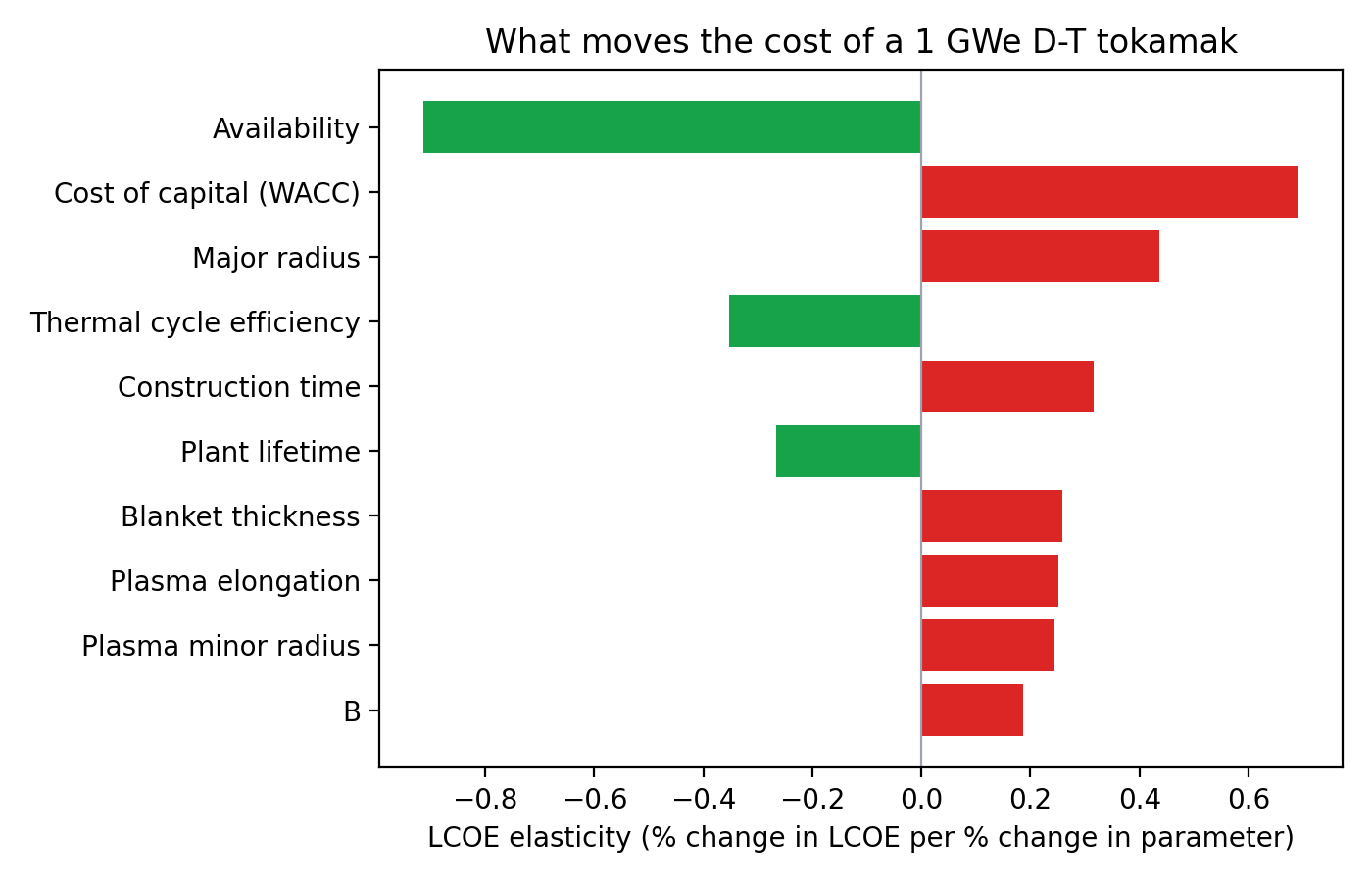
The chart says something worth pausing on: the two strongest levers on fusion electricity cost at this design point, availability and the cost of capital, are not physics parameters. The physics levers (major radius, elongation, blanket thickness) matter, but they queue up behind the boring ones.
The elasticity vector is also the discipline that keeps a model like this honest. A costing framework with enough free parameters can be tuned to produce any answer you like, and in a field where calibration data is sparse, that is a real failure mode. Differentiability makes the knobs visible: if a parameter has near-zero elasticity, calibration effort spent on it is wasted, and if a result depends on a parameter nobody can defend, the tornado chart will say so.
Where this sits in the landscape
The established open systems codes, PROCESS, bluemira, FUSE.jl, and FAROES, go far deeper on tokamak engineering than we do, and remain the right tools for a detailed D-T tokamak design study. pyFECONS and its CATF extension span concepts and fuels as parameterized cost models, with the physics encoded in the inputs rather than the model. What no existing open tool offers is the intersection 1costingFE was built for: aneutronic fuels and DEC, steady-state and pulsed concepts, concept-aware physics, and autodiff sensitivity in one call. The methodology paper (compiled from the same tag this post describes) and the per-account justification documents are the methodology reference.
What is shaky
This is an early release, and the honest list is short but real.
The deepest item is structural: the framework takes power and geometry as two separate inputs. Geometry drives the component costs; power sets the LCOE denominator. A costing framework has no business pretending to know every concept’s internal physics well enough to derive one from the other, so nothing enforces that the geometry you specify can actually deliver the power you ask for. We lean on published design points, where the concept’s developers have already done that work; the fusion-tea pipeline ingests them.
Beyond that: the building and tritium-plant scope for aneutronic fuels is calibrated against thin reference data, because few aneutronic reference designs exist to calibrate against. And pulsed inductive DEC is physically modeled but has never been validated at reactor scale by anyone, so treat its efficiency defaults with the same skepticism we urged in the DEC post. We would rather be corrected than deferred to on all of it.
An invitation
In rough order of how much it helps us:
Reference cost data. If you have real numbers for any account, magnet costs at current REBCO prices, balance-of-plant from recent fission or combined-cycle projects, capacitor pricing at relevant duty cycles, we want them. Anonymized is fine; sourced is better.
Account-level review. Pick one file in
docs/account_justification/, read it, and tell us where it is wrong. Specific beats general.Validation cases. A published design with a full cost breakdown that we cannot reproduce by overriding the relevant accounts is a case we want to study.
Bug reports. GitHub issues. We respond.
Play with the 1costingfe explorer. Clone the repo. Run the examples. The test suite passes, the numbers in our posts regenerate from the example scripts, and the fastest way to make the model better is for someone outside the project to find the place where it is wrong.