

Starting from a cost premise
1cFE’s central question is whether fusion could produce electricity for one cent per kilowatt-hour, and what would have to be true for that to happen. The arithmetic is demanding. At a 7% real cost of capital, a 30-year life and a 95% capacity factor, each $1,000 of capital cost per kilowatt adds about 1¢/kWh on its own. A new combined-cycle gas plant costs $868 to $921 per kilowatt to build, in 2023 dollars (EIA, 2025). A fusion plant selling at 1¢/kWh has to be built for about that, fusion core included, and run at low operating cost. Even a D-T plant whose fusion core cost nothing comes out near three times the target under the baseline assumptions of our cost-floor analysis.
Most coverage of fusion treats it as a race to net energy. We work backwards from the cost target: could a mature fleet of a given approach ever sell electricity this cheaply, and what stops it if it cannot?
Our post From Papers to Plant Economics costed 38 fusion concepts through one pipeline. That told us which questions to study more closely. This post starts from the other end: the reasons a fusion plant could get cheap enough to approach the target. Fewer neutrons could cut shielding, replacement and licensing costs. Direct conversion could cut the fusion power needed per unit of electricity. A small device could be built and rebuilt fast enough to learn its way down the cost curve.
A corridor is the set of designs and operating conditions we explore from one starting premise: the combinations of fuel, confinement, power conversion and plant design that could make that premise work. A corridor is wider than any one company or concept, and includes approaches not being pursued.
This post proposes six corridors. They overlap. A design can draw on several premises, and the list will change as the work goes on.
A study of each corridor follows. Some cost selected plant designs, while others examine coproduct revenue or the production and demand needed for costs to fall. Each tests part of the premise. A result for one design or scenario says nothing final about the corridor. We publish the method and the first studies so others can test the premises, cost other designs, and propose corridors we have missed.
Definitions: 1¢/kWh means $10/MWh in 2025 dollars, at the plant gate, for an nth-of-a-kind plant, with no subsidies and no byproduct revenue credits. The byproduct-value corridor is the exception; it reports the electricity-only cost and the electricity price needed after net byproduct revenue. Financing and availability conventions are in our cost-floor analysis.
The six corridors are:
The most-mature corridor. Test whether the most mature D-T magnetic approaches can reach the target through engineering, construction, maintenance, and financing improvements alone.
The pulsed-plant corridor. Test whether a pulsed architecture can drive down overall cost while balancing four coupled cost terms: amortized driver costs, consumable target and liner costs, engineering gain, and chamber size.
The direct-conversion corridor. Test whether converting charged particles to electricity directly, at higher efficiency than a thermal cycle, can shrink the fusion core, reduce fuel demand and reduce the power conversion balance of plant enough to reach 1¢/kWh, and which fuels and confinement approaches best exploit it.
The minimal-neutron corridor. Test whether all but eliminating the neutron burden can remove enough plant complexity, replacement cost, shielding, fuel-cycle burden, and licensing weight to outweigh the lower fusion power density and higher plasma temperature the fuel requires.
The byproduct-value corridor. Test whether non-electric outputs, such as transmutation products and high-grade heat, can carry enough revenue to change fleet-scale economics.
The compact-learning corridor. Test whether small devices can find enough early customers, improve through repeated production and development, and reach larger markets at lower cost, conditional on a workable net-electricity product.
The six candidate corridors
Each corridor is described as follows: the premise, the designs that could carry it out, and what an analysis of it has to consider. Three lines close each one: the cost hypothesis, what would prevent it, and our going-in view, the prior we hold before the analysis. Named approaches, concepts and companies are test cases.
The most-mature corridor
The most mature D-T magnetic approaches have the least new science left to discover, so engineering, construction, maintenance and financing improvements alone might carry them to the target. An analysis of this corridor takes the plasma physics as solved: sustained operation, exhaust handling and tritium self-sufficiency are assumed. Magnetic D-T is the most mature approach in fusion from both an experimental and a theoretical perspective, with more than a hundred tokamaks constructed and operated since the 1950s alongside a deep stellarator lineage. If this corridor cannot reach 1¢/kWh, the reason is plant economics, and the result sets the D-T baseline for the other corridors.
The likely binding challenges are construction capital cost and uptime. Can the capital cost of building the plant be driven down far enough, through automation, a smaller footprint and simpler construction, and shorter permitting and build times? And can reliability and component life be made high enough to hold capacity factor up, given neutron damage to the first wall and blanket and the replacement outages that follow? We expect capital cost to dominate the corridor and uptime to be its largest downside risk. The first is an engineering, construction, and financing question. The second is mostly an engineering question, though physics enters it through material degradation under sustained neutron flux and plasma behavior over long, continuous operation. Balance of plant is common to every corridor, and driving it down is a cost lever we push on throughout. This corridor’s own levers are the magnet account, the cost of capital, and component life.
Candidate designs span the magnetic D-T family: stellarators, compact HTS tokamaks, and other magnetic D-T systems, across HTS and low-field, compact and large. Pulse structure is a plant variable inside the corridor, since some proposed compact HTS designs run long pulses bridged by thermal inertia. Maturity selects the test cases; the cost reduction itself must come from mechanisms such as higher field and power density, which shrink the machine per unit of power, alongside automation, simpler construction, and faster builds. The designs should be compared on plant cost, maintainability and build complexity, and at least one taken up an evidence ladder to find where the D-T capital and uptime floor sits.
Cost hypothesis: capital cost reduction (automation, footprint and construction simplification, faster permitting and build) and reliability and component life high enough to hold capacity factor up.
What would prevent it: the achievable capital cost and uptime, net of neutron-driven replacement, leave the plant above the target even with the field’s most mature physics and an aggressive build.
Going-in view: our published cost-floor analysis puts free-core D-T at about three times the target under baseline assumptions, approaching the target only under extreme scale, availability, and financing assumptions that leave almost no budget for the fusion core. The assumptions behind that floor (thermal conversion train, construction grade, replacement cadence) are the ones to test, and the question is whether any engineering route opens credible headroom for the core.
The pulsed-plant corridor
Inertial fusion is the only approach to have achieved scientific breakeven (fusion yield exceeding the laser energy delivered to the target), though it trails on driver and target supply chains. For a commercially viable plant, magnetic confinement reactors need about one order of magnitude cost reduction on REBCO tape, a high-temperature superconductor already sold commercially. A pulsed plant needs, as order-of-magnitude markers, one to two orders of magnitude off its driver cost and about four orders off its target cost, with no commercial analogue for either. The driver figure follows from NIF’s $3.5B facility cost and Xcimer’s claimed >30× reduction; the target figure from General Atomics’ decomposition of a $2,500 target to a $0.25 requirement. These figures show the size of the gap. An analysis has to work out the driver and target costs a plant can afford at a given yield, driver efficiency, repetition rate and replacement schedule. The corridor is defined by per-shot economics: any architecture whose costs accrue shot by shot sits inside it, whatever its hardware and whether or not each shot consumes a target. A successful pulsed architecture will balance four interconnected factors simultaneously:
Engineering gain sets plant size: at fixed net power output, higher Q_eng means a smaller gross plant with less recirculating power.
Lifetime driver costs scale nonlinearly with driver-energy-per-shot and linearly with cumulative cycle count.
Consumable target or liner cost must stay economical after multiplication by millions of shots per year. In architectures with no consumable, this term goes to zero and the driver-cycle and chamber terms dominate.
Chamber cost scales with yield-per-shot based on whichever physics constraint binds: the per-shot fluence limit or the time-averaged neutron wall loading.
At fixed net power, repetition rate sets the required yield-per-shot and moves all four factors at once in opposing directions. In our models, driver capital and chamber size fall as rep-rate rises, while recirculating power and consumable cost rise with it. LCOE as a function of rep-rate then shows an interior minimum for each configuration, set by its gain, driver efficiency, and component wear as much as by its driver, chamber, and consumable cost curves. Finding that minimum is how we test pulsed-plant configurations against the target.
Cost hypothesis: low-cost, efficient, and resilient drivers developed in conjunction with simple, scalable targets; high engineering gain, enabled by good coupling and power conversion efficiencies; and a minimized chamber, for example through a liquid first wall.
What would prevent it: the target and driver supply chains cannot scale to the required cost floor and manufacturing cadence, or driver component lifespans cannot reach the cycle counts that the repetition rate, replacement cost, and outage budget require (of order 10⁹ cycles for high-repetition designs).
Going-in view: our preliminary models find candidate configurations at either end of the rep-rate spectrum, each cheap for a different reason and neither yet at the target. A low-rep plant carries more of its cost in driver and chamber capital; a high-rep plant is more exposed to target and replacement cost. In both, the cost of capital and the power cycle are the largest levers.
The direct-conversion corridor
Converting charged particles to electricity directly could raise the fraction of fusion power delivered as net electricity. Charged-particle capture is theoretically capable of efficiencies above 90%, about double the 40% typical of a thermal conversion cycle, though demonstrated hardware sits well below the theoretical figure and net plant efficiency is the number that decides the economics. Higher conversion efficiency means a given net electric output needs less fusion power, a smaller fusion core, and less fuel.
Replacing the thermal conversion train is the corridor’s second candidate advantage, and our published direct energy conversion analysis is skeptical of it for the converters it costed: the power electronics that replace a turbine can cost as much as or more than the turbine. So we treat efficiency, core size, and fuel demand as the corridor’s levers; the pulsed inductive case, where the recovery hardware doubles as the driver, has to be priced on its own.
Direct conversion has now been demonstrated on a fusion device at small scale: in June 2026 Realta Fusion reported single-stage conversion on the WHAM mirror at about 100 V and several amps, while noting this is neither net electricity nor large-scale conversion of fusion-born power. Direct conversion can also be added to a plant whose primary conversion is thermal, to trim recirculating power. That add-back belongs with the minimal-neutron corridor; this corridor covers plants where direct conversion is the primary route.
We treat D-³He as the leading test case: most of its energy emerges in charged particles a direct converter can act on, and its bremsstrahlung losses are lower than for p-B11, so less energy is radiated away before it can be converted. It is not fully clean, and we model it that way. D-D side reactions still emit some neutrons, so the shielding and activation savings are partial.
The main problem for a D-³He plant is the ³He fuel cycle. No commercial-scale ³He supply exists on Earth, and the candidate routes to one are external production, lunar recovery, and breeding in the machine itself, since D-D side reactions produce ³He directly and tritium that decays to ³He with a twelve-year half-life, which means a large on-site tritium store while it decays. The gate is therefore net fuel-cycle closure: whether breeding rates, isotope separation, decay lag, recovery losses, and startup inventory can close the loop, or whether an external source can scale instead. That unclosed fuel cycle, alongside the confinement challenge itself, is plausibly why so few programs pursue this fuel. The pulsed magnetic-compression FRC with inductive direct capture is the most visible D-³He example today, which reflects who is building; the best confinement route to the fuel is an open question. If the fuel cycle closed, mirrors, other magnetized-inertial schemes, and steady-state magnetic approaches would all merit assessment, alongside direct-conversion routes on other fuels. An analysis has two questions in order: whether a ³He fuel cycle closes at plant scale, and what the plant costs at each evidence grade if it does. Our first pass takes the leading design; other confinement and conversion approaches remain to be costed.
Cost hypothesis: direct conversion raises the fraction of fusion power delivered as net electricity, shrinking the fusion power, core, and fuel a given net output requires.
What would prevent it: the efficiency, core-size, and fuel savings do not move the achievable LCOE enough, or, for a D-³He plant, the ³He fuel cycle does not close at plant scale, confinement gain does not reach breakeven, or DEC efficiency net of power electronics falls below what a 1¢/kWh plant requires.
Going-in view: our published analysis is skeptical that direct conversion lowers the industrial plant-cost floor; its plausible value is reducing the fusion power and fuel a plant requires. For the leading D-³He design the gates are the yield a shot can return at its stated burn time, the driver’s cycle life, and ³He fuel-cycle closure. On the public record no pulsed D-³He device has produced a net-power shot, so every cost estimate is conditional on one. Whether other fuels offer a direct-conversion route worth costing is open.
The minimal-neutron corridor
Reducing neutron production could remove the need for tritium breeding and reduce shielding, material damage and replacement outages. In D-T, neutrons carry about 80% of the fusion power. In representative reactor power-balance models, D-³He cuts the neutron power fraction by about an order of magnitude, and p-B11 by two to three orders of magnitude. In a D-T plant the neutron flux is integral to operation: the breeding blanket uses it to make the tritium the reactor consumes. The same flux imposes several of the largest cost and reliability loads in the design: the heavy shielding, the 14 MeV damage that degrades the first wall and drives replacement outages, the remote maintenance, and the tritium inventory with its licensing weight. A fuel that needs no bred tritium and produces few neutrons sheds the breeding blanket and shrinks the shielding and replacement burdens, though a first wall and heat-capture structure remain, since much of a p-B11 plasma’s power arrives as bremsstrahlung photons. A lower neutron power fraction does not by itself set component life; wall flux, spectrum, and fluence in a given machine do, so replacement has to be costed for the machine in question.
p-B11 is the leading candidate because its primary reaction produces charged particles, though its neutron output is not literally zero in a real plasma, where side reactions and impurities still produce some neutrons. The fuel needs much higher plasma temperatures than D-T and releases less energy per reaction, so a p-B11 plant needs better confinement and a larger or denser core for the same output. The premise is that the savings on structure and uptime outweigh that cost.
The open question is which geometry can confine p-B11 well enough to realize any of this. Recent bremsstrahlung analyses (Ochs et al. 2026) and radiation-hydrodynamic simulations from HB11 Energy (Morozov et al. 2026) make laser ICF look very hard for this fuel, which pushes attention toward magnetic approaches. Among the magnetic options, our working hypothesis is that the mirror (especially high-mirror-ratio or centrifugal configurations with alpha channeling) is where the low-neutron advantages of complexity, uptime, and siting are most pronounced, because its open geometry offers ways to manage particle exhaust and recover escaping charged-particle energy. Whether that translates into better plant economics than a spherical tokamak or an FRC depends on the coupled electron and ion power balance, confinement and end losses, alpha removal, and heating and conversion efficiencies. Our first analysis costs one mirror design with the physics assumed; like-for-like power balances across geometries remain to be done. What no geometry escapes is the physics that follows from the higher temperature and lower yield: whether bremsstrahlung losses can be held below fusion power, whether alpha ash can be removed and exhausted without spoiling confinement, and whether the gain a power plant needs, far above scientific breakeven (Q>1, fusion power exceeding the power required to heat and sustain the plasma), is reachable at all. Demonstrated performance in every p-B11 geometry sits well short of breakeven today, so any cost estimate has to list the plasma performance it assumes and report the plant cost if that performance is reached.
Cost hypothesis: a low neutron flux removes the breeding blanket, shrinks shielding and neutron-damage replacement, and lifts the tritium licensing burden, and the fuel adds no breeding step. If the required gain is achieved, these savings compound into lower capital cost, higher uptime, and lighter permitting.
What would prevent it: no credible operating point delivers enough net electric output, after bremsstrahlung, heating, confinement, alpha removal, and conversion losses, to meet the target within defensible plant cost and component life. Reactor-relevant p-B11 performance remains undemonstrated in every geometry. Recent theoretical work (Ochs and Fisch 2024) identifies conditional routes that lower the required performance, through mechanisms not yet validated at reactor conditions.
Going-in view: structurally one of the most attractive corridors if the required gain is achieved, gated on plasma performance that has not been experimentally demonstrated. The analysis therefore prices what success would be worth and lists what it would require.
The byproduct-value corridor
A plant that earns from something other than electricity needs a lower electricity price to break even. Two byproduct streams follow from the plant’s physics. A third, fuel made from the plant’s own electricity, inherits the plant’s electricity cost and belongs in the same analysis. The first uses the neutron flux as a tool. In a D-T reactor a high neutron flux is necessary to breed the tritium that fuels the reactor, and that same flux can transmute feedstocks into radioisotopes and other higher-value materials. The second is high-grade heat, meaning heat delivered at several hundred degrees Celsius and above, hot enough to drive industrial processes such as hydrogen production and chemical synthesis. Heat at those temperatures sells at a premium over the low-grade heat used for space heating or desalination, though generally below electricity per unit of energy, and it needs a colocated customer. Either stream can also serve as bridge revenue during the long pre-commercial period when fusion plants cannot yet survive on electricity sales alone. This is the one corridor whose premise is a business model. It may count for more as a bridge for early plants than as a fleet-scale route to 1¢/kWh, and an analysis has to keep the two apart.
There are two open questions inside it, and neither is the confinement architecture. The first is the source. Any suitable neutron or heat source can in principle host a byproduct stream, and the likeliest configuration is integration into an existing D-T reactor design. Isotope production adds system complexity for feedstock introduction and product separation, and it interacts with the tritium breeding system; some proposed schemes use neutron-multiplying transmutation layers intended to serve breeding and production at once. The second question, and the one that decides the corridor, is the product. Which outputs (medical or industrial radioisotopes, transmutation of feedstocks into higher-value materials, high-grade process heat) have markets deep enough to carry a meaningful share of plant revenue, and how do their prices behave as fusion-scale supply arrives? The proposed products range from thin medical-isotope markets to deep commodity markets, including a published proposal to transmute mercury into gold (Marathon Fusion). Products should be screened on market depth first, setting aside those that saturate below fleet scale, before any are priced.
Our target is large-scale, low-cost electricity. A lucrative byproduct sold into a market of limited size could sharply lower the electricity price a small number of plants need, and that has value: it could seed early deployment and fund the first plants through the period when electricity sales alone cannot. But a thin, high-value market saturates. It might support the first plant but not the tenth, so it does not obviously scale to a fleet producing cheap electricity. Both effects need numbers: how much LCOE headroom a realistic byproduct stream buys for the early plants, and what caps that headroom as the fleet grows, whether feedstock supply, siting, or price. The corridor also tests the electricity-only convention, and for heat the gigawatt-scale one, since a plant sized to a heat customer may beat a large one selling only power, at least until the market fills.
Cost hypothesis: a salable byproduct (transmutation products, isotopes, high-grade heat) carries part of the plant’s cost.
What would prevent it: the byproduct market is too thin to absorb production at fleet scale, the product price collapses as supply grows, or the net margin after integration, processing, and qualification costs is too thin to move the electricity price even in a deep market.
Going-in view: the effect is real and can sharply lower the price a small number of early plants need, which helps deployment, but it is bounded by market depth and may not scale to a low-cost electricity fleet. We want to quantify both the early headroom and what caps it as the fleet grows.
The compact-learning corridor
Small devices may be cheaper and faster to build, test and revise. They may also serve customers whose power needs are too small for a large plant and whose alternatives are expensive. Early sales could support repeated manufacture and operating experience, allowing later units to reach larger, more price-sensitive markets. The question is whether enough customers at each price can support the production and improvement needed to reach 1¢/kWh.
Our post Material Multipliers and Learning Curves explains how a component’s material multiplier, the ratio of its finished cost to its raw material cost, helps bound the scope for cost reduction. Its learning rate describes the reduction per doubling of cumulative production. Smaller units may support faster growth in completed production because individual purchases require less capital and can serve smaller customers. Whether that produces faster cost reduction depends on demand, delivery times and which manufacturing experience transfers between units.
Development speed is a related advantage. A device rebuilt on short cycles can test changes and adopt better components sooner. But fast experimental iteration, manufacturing learning and plant qualification are different processes. Reworking a prototype does not add a completed commercial unit, and a new component may need testing before it can enter production. Learning transfers only where the repeated hardware and processes remain relevant to later plants.
Solar PV followed a version of this sequence. Its small minimum viable scale allowed early sales into satellites, remote monitoring and off-grid systems before utility markets became accessible. The learning-curves post compares it with concentrating solar, which also became cheaper but sells in plants of about 100 MW, earning its doublings one large project at a time. Fusion has additional constraints: a small plasma may still need substantial power supplies, vacuum equipment, cooling and shielding. An analysis of fusion experience rates (Tang et al. 2026) links the large unit size, complexity and customization of dominant designs to rates of 2 to 8%. Those rates are inferred from technology characteristics and expert elicitation, since no deployed fusion fleet exists to measure. A compact design would need to show which costs could improve through repetition and how far they could fall.
The first study examines how early customers, production lead times and manufacturing learning could support a transition from expensive first units to cheaper electricity. It uses hypothetical 10 MWe and 1 GWe products to make the required deployment explicit, without specifying a fuel or confinement scheme. Starting costs, learning rates, minimum costs and production schedules are chosen scenarios. Establishing a reactor design that can deliver those products remains a separate task.
A working net-electricity product is a condition of the premise. Candidate approaches include compact electrostatic and Z-pinch systems, whose integrated performance, component life and service requirements still need to be established. Smallness also has costs: many small units can duplicate equipment and staffing that a larger plant shares. Later deployment could use repeated modules, larger individual reactors, or both. Any move to a larger design needs to identify which experience transfers and which equipment requires new development and qualification.
Cost hypothesis: small units can reach paying customers early, supporting repeated production and development that reduce the cost of later units and open larger markets.
What would prevent it: no workable net-electricity product emerges, early demand or funding is insufficient, production grows too slowly, or duplicated equipment, qualification and operating costs leave too little room for learning to reach the target.
Going-in view: compactness could make early deployment more affordable and development faster. Reaching 1¢/kWh also requires sustained demand, production and cost reduction beyond those early markets. The first study quantifies those requirements under explicit assumptions; the physics and engineering of a product that could meet them remain open.
The cost-down lever map
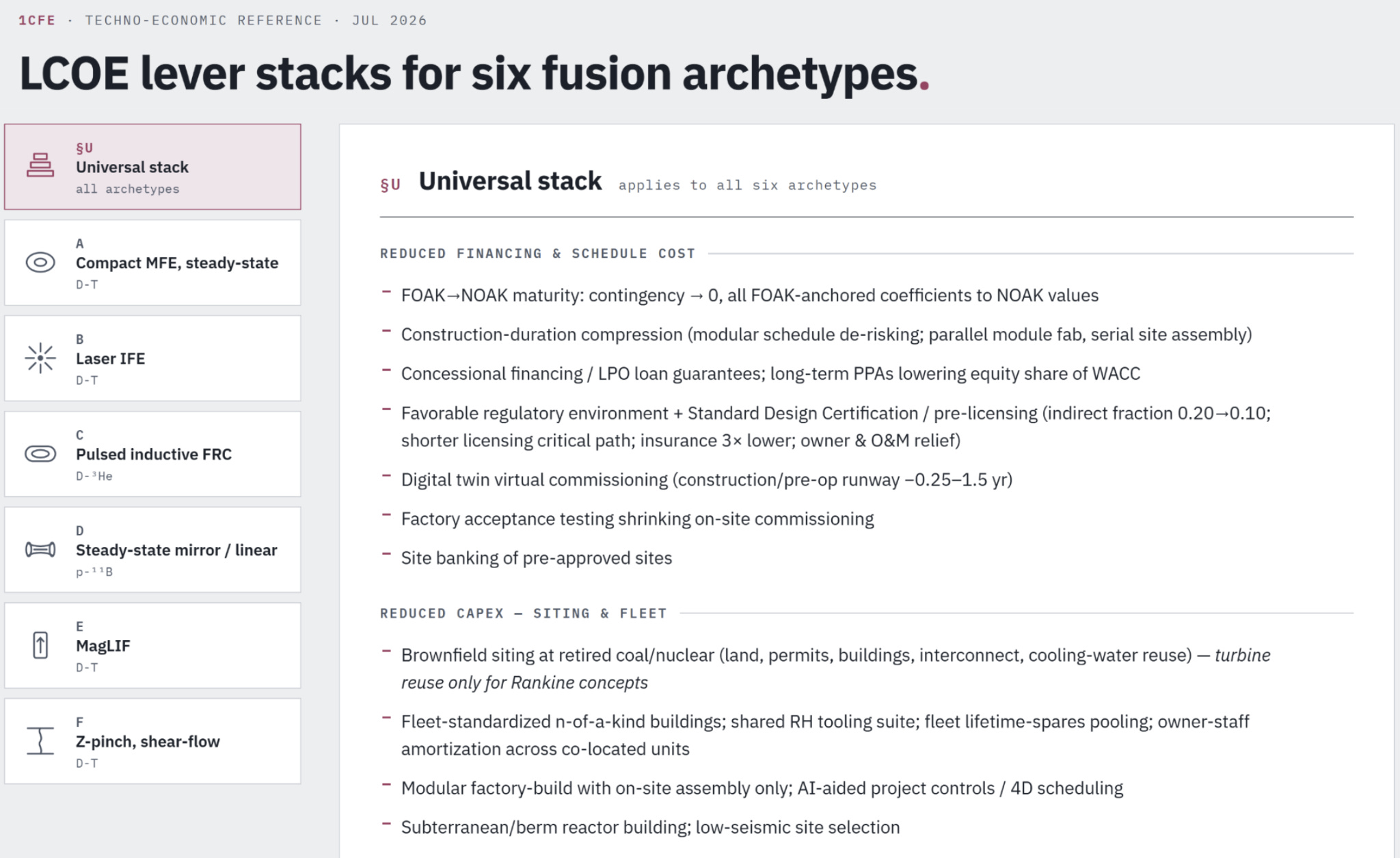
Alongside the corridors, we have outlined a broad list of cost-down levers, some of which apply to every fusion reactor. The list errs toward optimism about how far each lever could move. This tool maps the techno-economic drivers behind the most favorable LCOE case of six representative fusion archetypes, spanning confinement families and fuel cycles, against the ~1¢/kWh target. The six archetypes are representative concepts chosen to span the field; they are a separate grouping from the six corridors in this post.
The levers were surveyed account-by-account across the standard fusion cost-accounting structure (CAS10–90 and the CAS22 reactor-equipment sub-accounts) and cross-checked against our 1costingFE framework. Each lever is placed under its dominant cascading effect: reduced CAPEX, increased availability, increased net electric output, reduced OPEX, reduced fuel-cycle cost, or revenue offsets. If we are missing a cost reduction, tell us at 1cf.energy/contact.
A thumbnail of the cost-down lever map; click through for the interactive version
What comes next
The first studies use conditional plant costing, coproduct economics and deployment scenarios to examine different parts of these premises. They distinguish evidence from extrapolation and speculation, while stating the assumptions specific to each analysis. A synthesis will compare the requirements, evidence and unresolved questions across all six. Plant-cost results will be compared under common plant and financing assumptions where the cost boundaries match. Byproduct cases will report the electricity price needed after net coproduct revenue, and compact learning will contribute its deployment requirements and timeline. The synthesis will also publish the scoring lens we keep over the documented concepts in the field (public explorer).
In detail, our cost-floor analysis puts free-core D-T at about $29/MWh at baseline (1 GWe, 85% availability, 7% cost of capital, 30-year life, six-year build), nearly three times the target. Under an aggressive set (95% availability, 3% cost of capital, 50-year life, three-year build) it reaches about $14/MWh at 2 GWe, and $9.5/MWh at 5 GWe with 2% money. p-B11 gives about $17, $7 and $5/MWh on the same cases. The aggressive cases assume government-backed finance, which we treat as a sensitivity, and the floors depend on the model’s assumptions, including strong ones about the radiation-specific plant a p-B11 design sheds. Any design that reaches the target has to fit its fusion core inside that gap.
The models and data are open so others can rerun the analyses, cost other designs and combine premises we have treated separately. The studies name concepts and, where the evidence supports it, companies, as factual reference points.
Tell us where the premises are wrong, which designs we should cost next, and which corridors we have missed: 1cf.energy/contact or an issue on our GitHub.
Conflict of interest
Damien Scott and Tal Rubin are co-founders of Borealis Fusion, a company developing proton-boron-11 fusion. Astera Institute is an investor in Borealis Fusion. This post was produced within the 1cFE residency at Astera Institute. The minimal-neutron corridor describes the fuel Borealis Fusion is pursuing; its framing here follows the same standard as the other five corridors, and the corridor studies that follow publish their assumptions, code and evidence grades in full so that readers can check them.
Originally published at 1cf.energy.