

From fewer neutrons to a simpler plant
The six-corridors post starts from a cost premise: all but eliminating fusion’s neutron burden could remove the need for a tritium-breeding blanket and reduce shielding, material damage and replacement outages. The minimal-neutron corridor asks whether those savings can outweigh the harder plasma physics and bring electricity toward 1¢/kWh. That leads to two choices: which fuel minimizes the neutron burden, and which confinement approach can make best use of it.
Why p-B11
Deuterium-helium-3 (D-He3) produces far less neutron power than deuterium-tritium (D-T), but it retains deuterium. D-D side reactions produce neutrons and tritium; any tritium that subsequently burns produces more neutrons. Removing tritium before it burns reduces that second contribution, but does not remove the D-D reactions. Proton-boron-11 (p-B11) avoids this deuterium reaction chain. Its principal reaction produces three alpha particles, with a much smaller neutron contribution from side reactions and impurities.
The IAEA’s indicative comparison puts the fraction of fusion energy carried by neutrons at about 80% for D-T, 5% for D-He3 and 0.1% for p-B11. These are approximate values that depend on plasma conditions and side reactions. If the objective is to approach the lowest neutron burden with abundant terrestrial fuel, p-B11 is the leading choice. Its hydrogen and boron fuel requires no tritium breeding, and neither fuel isotope is radioactive. Residual neutrons still require shielding and activation analysis.
The cost is a much harder burn: temperatures several times those of D-T, about half the energy per reaction, and substantial bremsstrahlung losses as X-rays. Choosing the fuel therefore does not settle the confinement question.
Why a magnetic mirror
The working hypothesis of this study is that a magnetic mirror is the best candidate to turn p-B11’s fuel advantages into low electricity cost. A straight central cell surrounded by repeated coils and wall panels offers a relatively simple construction geometry. Its open ends provide a route for helium ash to leave the plasma. Together, these features offer ways to reduce plant complexity while addressing the fuel’s confinement and exhaust requirements.
Ash removal has to preserve useful energy. In alpha channeling, waves transfer energy from fusion-produced alpha particles to the fuel while helping remove the ash, limiting the energy passed to electrons and lost as radiation. Mirror theory describes how this could direct alphas into trajectories that escape through the ends, without first transporting them across the plasma to its outer edge (Zhmoginov and Fisch, 2012). Separate p-B11 power-balance studies show why channeling alpha energy to protons could ease the confinement requirement (Ochs et al., 2022). Combining these mechanisms in a working p-B11 mirror remains to be demonstrated.
The difficulties of pure-p-B11 inertial fusion give another reason to investigate magnetic confinement. Morozov et al. (2026), including researchers at HB11 Energy, simulated highly compressed p-B11 targets. They found ignition possible, but insufficient energy gain for the inertial power-plant conditions they studied. A D-T ignition region did not resolve the shortfall. They proposed further study of D-T-containing mixtures, which would reintroduce neutron production. This result concerns the inertial route studied; it does not establish that a magnetic mirror will work.
The mirror’s main difficulty follows from the same open geometry: fuel and energy can also escape through its ends. Confinement, stability and selective ash removal must work together without consuming too much power (Mesa Dame et al., 2025). The cost study assumes those requirements can be met. A comparative cost advantage over other p-B11 geometries has not yet been established.
What this calculation assumes
This study prices one tandem mirror if the required plasma performance is achieved. It assumes a fusion gain of about 52 at 1 GWe: 40 MW of drive against 2,099 MW of fusion power, with 11.8% of gross electric output recirculating. The drive is held at 40 MW at every plant size, so the 3 GWe case assumes a gain near 150. These gains are model inputs, not demonstrated performance.
The drive requirement has not been established by a confinement calculation. A sensitivity scan from 10% to 90% recirculating power moves the extrapolations-tier cost from $26 to $139/MWh at 1 GWe; it stays under $37/MWh out to 50% recirculating. At the assumed drive, the design costs $26.1/MWh at 1 GWe and $22.8/MWh at 3 GWe on labeled extrapolations (tier 2), and $76.1 and $72.5/MWh on the records tier (tier 1). The 1¢/kWh target appears only in the speculative 3 GWe case, at $9.4/MWh. The ladder below separates the assumptions needed for each result.
The costed mirror design
The costed design is a p-B11 tandem mirror: a solenoid of high-temperature superconducting coils around a cylindrical plasma, 7 tesla at the design baseline and 10 tesla at the top of the ladder, mirror end cells whose throat coils run at three times the central field (21 tesla at the baseline, the class large coils have reached; 30 tesla at the top, which extrapolates the 32 tesla small-bore REBCO magnet class to throat bore), and exhaust tanks at the ends. Fusion power leaves the plasma through two channels, and both end as heat. Most of it, 83% of fusion power in the best published alpha-channeling scenario (Ochs et al., 2022, Sec. IV.B), is bremsstrahlung X-rays absorbed in the chamber wall; the rest leaves as charged particles along the open field lines into the end tanks. One combined cycle converts the heat at 53%, the cost model’s preset for a 600 C-class heat source (ledger, eta_th row).
The radial build carries no breeding blanket and no tritium systems. A first wall doubles as the heat collector: a graphite-faced, gas-cooled steel sandwich with supercritical CO2 channels, priced at the ITER first-wall panel class at the design baseline, where it sees about 1 MW/m², and higher up the ladder from its own bill of materials at the 10 MW/m² flux the ITER divertor is qualified to (Pitts et al., 2019); behind it a modest shield for the stray neutrons, then the coils. The field and the plasma pressure set the machine’s length: fusion power density scales as beta squared times field to the fourth, so the 7 tesla, beta-0.6 baseline carries about 1.3 megawatts per cubic meter and needs 225 meters of central cell at 1 GWe, its wall lightly loaded, while 10 tesla at beta 0.8 makes the same plant in 30 meters. Cost per kilowatt falls with plant size as the fixed costs spread over more meters of burning plasma.
An evidence ladder
We priced this machine on a ladder, so each dollar of descent shows its cost in believability.
Tier 0, the design baseline. The machine on demonstrated-class field and beta (a 7 tesla cell at the beta of 0.6 the Gas Dynamic Trap has held, the wall at the panel class qualified for the flux it sees), costed with the open-source 1costingfe model on the study’s plant environment: a 7% real cost of capital, a 30-year book life, a five-year build (the fission fleet’s serial builds), 20% indirects scaled with the build, an availability of 93% derived from the fission fleet’s between-outage record less this machine’s own maintenance, and ITER-class component prices.
Tier 1, records. Records apply in both directions. The design baseline already sits on demonstrated-class field and beta, so this tier reverts what remains: the power cycle from the 53% combined cycle to the 35% steam cycle that the water-cooled hardware the wall is priced as can actually drive, and the photon fraction to its unchanneled value, which costs nothing here but says the burn does not close. What it cannot price (the rotating tandem, the synchrotron-reflective wall, the p-B11 burn itself) it holds and says so, so the tier is a lower bound on what demonstrated physics would cost, not a device. Neither the build nor the cost of capital has a record, so both hold at their baseline values. The book life does: the operating US fission fleet runs under 60-year licences, so this grade takes 60 years against the 30-year baseline, the same ruling the D-T corridor studies make at their records rung.
Tier 2, extrapolations. First the design baseline comes back: the gas-cooled combined cycle and full alpha channeling are re-granted as labeled extrapolations, each with a mechanism and no record. Then the field steps to 8 tesla (a 24 tesla throat) and the beta to 0.7, on the rotation-shear argument the concept makes for itself; the heating chain takes the 95% efficient-heating scenario of Ochs and Fisch; the wall is priced from its own bill of materials at $1.0M/m², the conservative top of the build-up; superconducting tape moves to the low end of the published manufacturer projection band; the cost of capital to 5% real, a loan-guarantee blend with precedent and no fusion record; the book life to 80 years, the US DOE hydropower lifespan (US DOE); and the build to 3.25 years, the Kashiwazaki-Kariwa ABWR pair’s 37 to 39 months to fuel load (Omoto, 2002). Taken one at a time on the re-granted baseline, the cost of capital is worth $15.1/MWh at 1 GWe, the field step $12.1, the tape price $11.6, the beta step $8.8, the faster build $5.5 and the 80-year life $0.7 (a 60-to-80 step, since the records tier already holds 60); together the tier takes $50.0/MWh off the records tier, of which $20.4 is the baseline coming back.
Tier 3, speculation. The field to 10 tesla and the beta to 0.8 (a 30-meter machine), test-qualified wall fluxes run as steady state, tape prices below any manufacturer projection, a 3% real cost of capital and a 2.5-year build, the single-block combined-cycle gas timeline (Siemens Energy). It reaches $9.4/MWh at 3 GWe; at the baseline 7% real it would read $18.4, so cheap capital accounts for $9.0 of the descent. A bound only; it is no part of this post’s answer.

View the full table on 1cf.energy.
Note on tiers. This study’s plant environment is the direct-conversion study’s: a 7 / 7 / 5 / 3% real cost of capital, a 30 / 60 / 80 / 80-year book life, a 5 / 5 / 3.25 / 2.5-year build and 20% indirects scaled with the build, with availability derived from an outage schedule. The D-T corridor studies share the cost-of-capital and book-life ladders; they differ in carrying each design’s own build at the design baseline, quoting nominal rather than real rates, and stepping availability from 0.85 rather than deriving it. Read this study’s rungs against theirs grade for grade, with those three differences in mind.
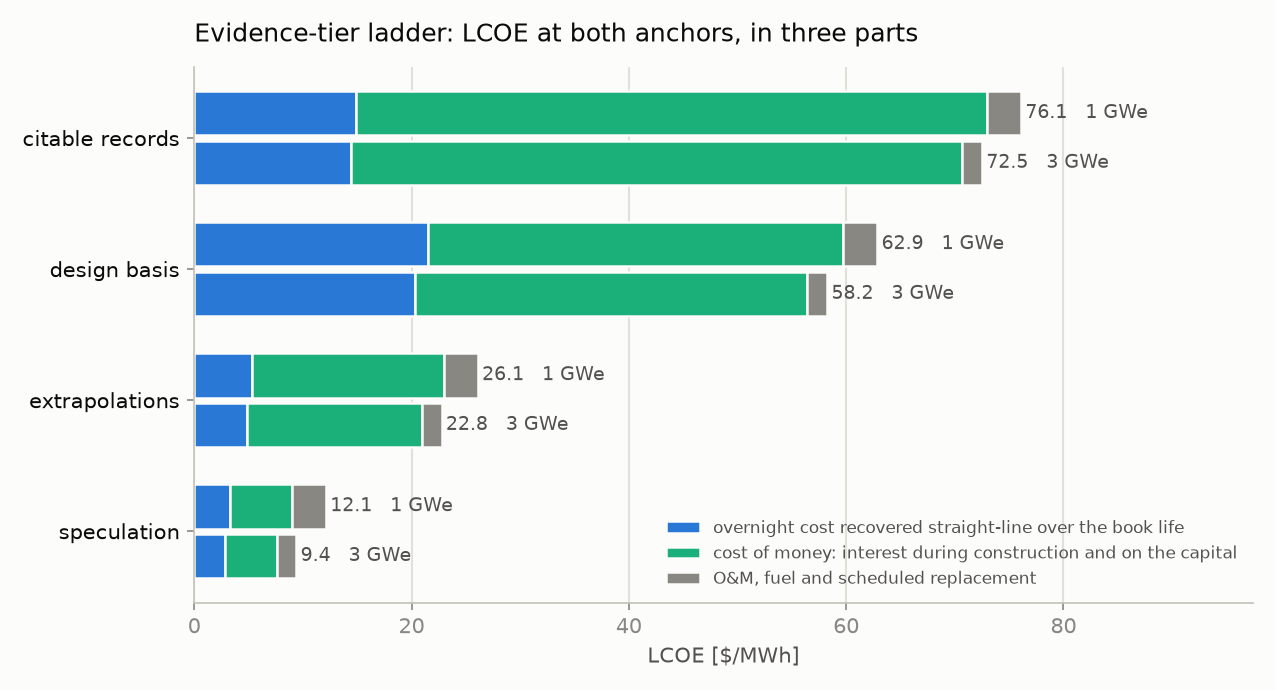
Figure 1: The evidence-tier ladder at both anchors, each bar split into the overnight cost recovered straight-line over the book life, the cost of money, and O&M, fuel and scheduled replacement. Cost of capital 7% real at tiers 0 and 1, 5% at tier 2, 3% at tier 3; book life 30, 60, 80, 80 years; build 5, 5, 3.25, 2.5 years.
What carries the cost down
The design baseline sets the starting point: the machine on demonstrated-class field and beta, priced on the plant environment above, comes in at $62.9/MWh (tier 0), at the top of the span of published fusion estimates, because a 7 tesla plasma at beta 0.6 needs 225 meters of superconducting solenoid to make a gigawatt. Above it, the records tier reverts the cycle to what water-cooled hardware can drive and reads $76.1/MWh at 1 GWe and $72.5 at 3 GWe (tier 1), a lower bound on demonstrated physics. The descent is the extrapolations tier, $50.0/MWh: $20.4 of it the baseline coming back, and the rest the cost of capital ($15.1 one at a time), the field ($12.1), the tape price ($11.6), the beta ($8.8), the faster build ($5.5) and the 80-year life ($0.7, a 60-to-80 step). Cheaper capital is a change of who bears the risk, not a technology, which is why the table quotes every tier at 7% real as well: at that rate the extrapolations tier reads $35.5/MWh. Uptime is not a lever here; it is derived from the fission fleet’s record and this machine’s own maintenance, and it is among the strongest sensitivities of the number, after the field and the beta.
The bremsstrahlung fraction, the radiative loss that makes p-B11 ignition so hard, does not appear in the cost of this plant. In a thermal-only plant every watt of fusion power is heat for the same engine whether it arrives as X-rays on the wall or as particles in the end tanks, so sweeping the photon fraction from the published 0.83 floor down to 0.50 leaves the tier-2 answer unchanged at $26.1/MWh (tier 2). Bremsstrahlung stays where the framing post puts it: in the burn physics that is the gate, and in wall engineering.
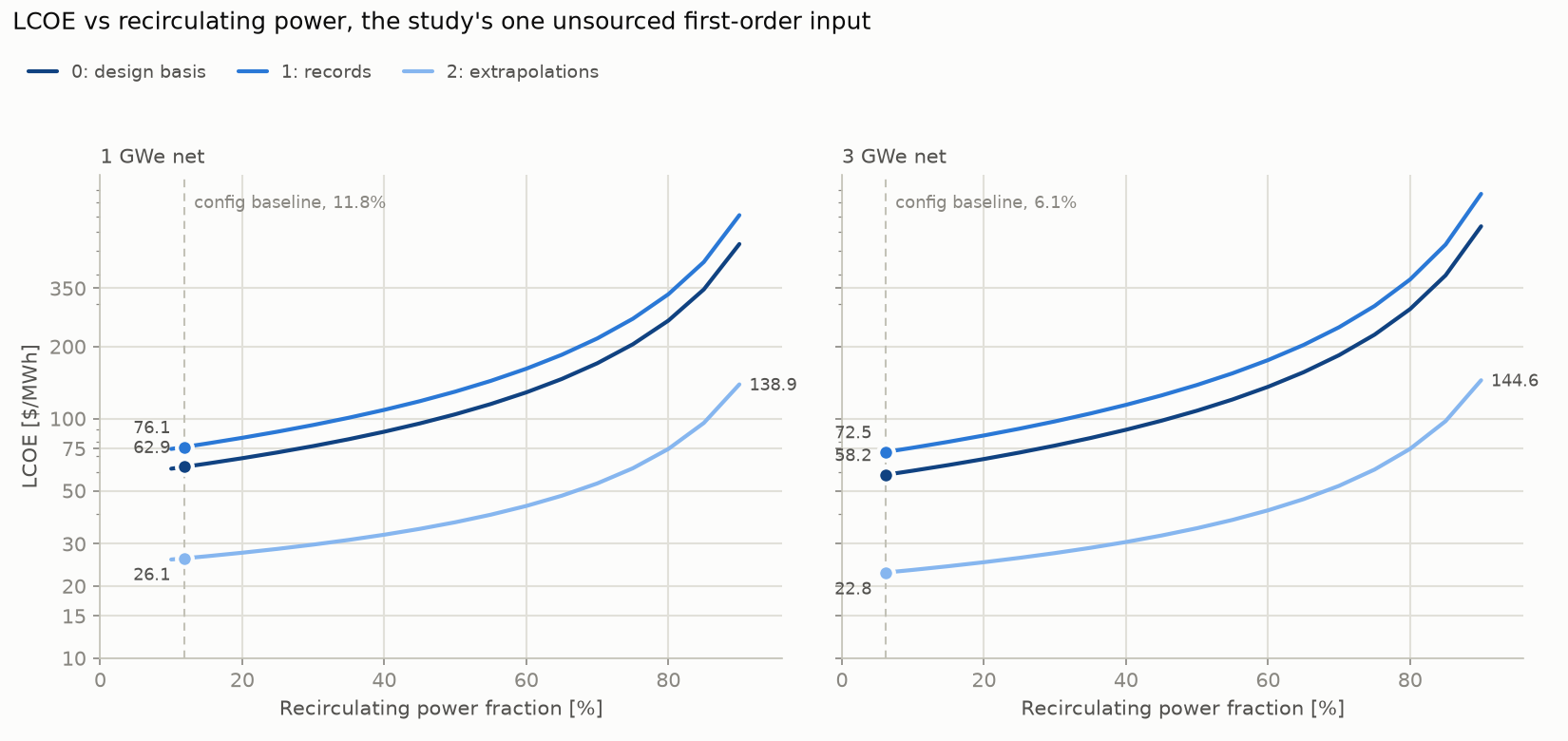
Figure 2: LCOE at 1 and 3 GWe against the recirculating power fraction from 10% to 90%, tiers 0 to 2; the design point (11.8% at 1 GWe, 6.1% at 3 GWe) is marked.
Checked against the earlier dispatches
The cost floor. Our first dispatch put the p-B11 free-core floor at $17/MWh, and this post’s fully costed $26.1 sits above it, as it should, and at 7% real ($35.5) well above it. The two are not on one basis: the floor was quoted at commercial project finance (7% nominal WACC, 85% availability, 30-year life), while this post’s extrapolations tier carries a 5% real cost of capital, a 93% derived availability and an 80-year life. The table reruns the floor dispatch’s free-core method under this study’s tier-2 conditions.

View the full table on 1cf.energy.
The fully costed plant sits above its matched floor at both anchors, and the decomposition reverses the earlier reading for this machine: at 3 GWe the priced fusion core adds $14.9/MWh (tier 2), twice the non-core plant. The earlier finding was that fusion’s cost problem lives mostly outside the core; for this fuel at extrapolation-grade field and beta the core is two thirds of the bill, and it is the field and the beta that set it.
Direct energy conversion. Our second dispatch found that a DEC overlay does not pay for itself on p-B11: the thermal plant converts the 83% photon channel either way, and the DEC captures only the 17% charged-particle margin. This machine prices no direct conversion. Electrostatic converters in the end tanks would move the answer by 0.3 $/MWh the wrong way at the demonstrated 48% conversion efficiency, and would gain 0.8 to 1.0 $/MWh at the published adiabatic bound of 0.75 (Rax, Kolmes and Fisch, 2025; tier 2). Both are at the edge of model precision, and the model charges nothing for procuring, maintaining and commissioning a system with no operating heritage.
Testing the mirror choice
This post costs one p-B11 geometry. The framing post’s working hypothesis is that the mirror is where the low-neutron advantages are most pronounced, to be tested with like-for-like power balances across geometries; this study does not perform that test. The other p-B11 confinement classes, the field-reversed configuration, laser-driven inertial confinement, the dense plasma focus, the electrostatic trap and toroidal magnetic confinement, remain to be costed on the same plant-side ladder. The study carries a first D-T mirror benchmark, sized by neutron wall loading, as the like-for-like fuel comparison for this geometry; this post does not draw on it. The decomposition above says how a geometry will enter: through its core cost, its recirculating power and its wall loading, against a core that is two thirds of the bill for this fuel. The mirror is the preferred starting point for the reasons above. Establishing that it is the lowest-cost embodiment of this corridor requires those comparisons on the same basis.
What must be true, and what could break it
p-B11 still makes neutrons. In-flight alphas make 2 to 5 MeV neutrons on fuel boron at about a thousandth of fusion power. The cost consequences are real and small: tens of centimeters of coil shielding, a low-activation materials posture and a small health-physics staff, together about $1.5–2/MWh at the design basis and well under $1/MWh from the extrapolation tier on. The operating posture near the wall is low-dose scheduled maintenance.
The extrapolations are individually argued and jointly heroic. Each tier-2 entry has a mechanism; the 80-year life and the loan-guarantee-class capital are each held by some real project, but no single project holds them at once.
The gain of 52 is a carried-over default. Every other first-order input is a record, a labeled extrapolation or a stated design commitment; the 40 MW drive is a default, and a mirror is an open machine whose drive is set by axial losses we have not modeled. The 10% to 90% sweep shows how strongly the result depends on that assumption.
“If it works” carries the whole result. Confinement, stability, alpha channeling at its published optimum, the field and beta the cheaper tiers grant (8 tesla at 0.7, then 10 tesla at 0.8; no mirror has held either), a wall face reflective enough to return the synchrotron radiation to the plasma, and the wall’s cost class (water-cooled ITER hardware classes carried onto the gas-cooled sandwich) are granted by construction; the records tier is where the physics is derated to what has been shown. The study prices the machine.
The shape of the answer
A p-B11 plant that works is an ordinary economic object: a long pressure vessel full of wall panels, some large power electronics and a heat engine. Priced on demonstrated physics it lands near $72/MWh at scale (tier 1, 3 GWe), a lower bound; on demonstrated-class field and beta, near $58/MWh (tier 0); priced with labeled extrapolations it reaches about $23/MWh (tier 2, 3 GWe), about 1.3 cents per kWh above the 1-cent target, or $31/MWh at the baseline cost of capital. The remaining distance does come from better plasma: a stronger field and a higher beta, which shorten the machine as the fourth power of the one and the square of the other, with cheaper superconducting tape and, shown separately on the ladder as financing, the cost of capital behind them. The plant-side savings are real and bounded, as the corridor’s going-in view had it, and the question that decides the corridor is the one this post cannot answer: whether a p-B11 plasma burns at a gain near 52 at all.
Study, ledger and code
The calculations use the open-source 1costingfe cost model at commit 91c306e or later. The study-specific code, figure scripts and record ledger are not yet publicly available. The article reports the study’s assumptions and results; independent reproduction will require release of those supporting materials.
Conflict of interest
Tal Rubin and Damien Scott are co-founders of Borealis Fusion, a company developing proton-boron-11 fusion. Astera Institute is an investor in Borealis Fusion.
References
Ochs, I. E., Kolmes, E. J., Mlodik, M. E., Rubin, T., and Fisch, N. J., “Improving the feasibility of economical proton-boron-11 fusion via alpha channeling with a hybrid fast and thermal proton scheme,” Phys. Rev. E 106, 055215 (2022). https://doi.org/10.1103/PhysRevE.106.055215
Ochs, I. E., and Fisch, N. J., “Lowering the reactor breakeven requirements for proton–boron 11 fusion,” Phys. Plasmas 31, 012503 (2024).
Pitts, R. A. et al., “Physics basis for the first ITER tungsten divertor,” Nucl. Mater. Energy 20, 100696 (2019). https://doi.org/10.1016/j.nme.2019.100696
Siemens Energy press release, “Completion of World’s Largest Combined Cycle Power Plants in Record Time” (the 2.5-year single-block build; cited in the ledger, construction_time_yr row). https://press.siemens.com/global/en/pressrelease/completion-worlds-largest-combined-cycle-power-plants-record-time
US DOE, Water Power Technologies Office, “Hydropower Basics.” https://www.energy.gov/eere/water/hydropower-basics
Omoto, A., “Ten reactor years of ABWR experience,” Nuclear Engineering International, 3 May 2002 (the Kashiwazaki-Kariwa 6 and 7 builds; cited in the ledger, construction_time_yr row).
Rax, J.-M., Kolmes, E. J., and Fisch, N. J., “Efficiency and Physical Limitations of Adiabatic Direct Energy Conversion in Axisymmetric Fields,” PRX Energy 4, 013007 (2025).
1cFE, “Fusion’s cost floor: what if the core were free?” https://1cf.energy/fusions-cost-floor-what-if-the-core-were-free/
1cFE, “Direct energy conversion.” https://1cf.energy/direct-energy-conversion/
1costingfe cost model. https://github.com/1cfe/1costingfe
Record ledger for the costed p-B11 mirror. Not yet publicly available.
International Atomic Energy Agency, “Experiences for Consideration in Fusion Power Plant Design Safety and Safety Assessment,” IAEA-TECDOC-2076 (2024), Sec. 2.4.4 and Table 1, pp. 13–14. https://www-pub.iaea.org/MTCD/publications/PDF/TE-2076web.pdf
Zhmoginov, A. I., and Fisch, N. J., “Applying alpha-channeling to mirror machines,” Phys. Plasmas 19, 055702 (2012). https://doi.org/10.1063/1.3701997
Morozov, I. et al., “Insufficient energy gain of pure proton-boron fuel for IFE: 1D radiation-hydrodynamic simulations,” Phys. Plasmas 33, 042705 (2026). https://doi.org/10.1063/5.0322446
Mesa Dame, A., Ochs, I. E., and Fisch, N. J., “Energy Spectrum of Lost Alpha Particles in Magnetic Mirror Confinement,” arXiv:2412.05890, version 2 (2025). https://arxiv.org/abs/2412.05890v2
Originally published at 1cf.energy.