

The direct-conversion corridor starts from a cost premise: converting a larger fraction of fusion power into net electricity could reduce the fusion power, core size and fuel required for a given electrical output. Following Six Candidate Corridors to 1¢/kWh Fusion, this study examines a plant that relies on direct energy capture as its primary route to electricity.
That choice quickly brings us to deuterium-helium-3, or D-He3. D-T releases about 80% of its fusion energy as neutrons. The primary p-B11 reaction produces charged particles, but in the plasma regimes examined in our earlier direct energy conversion analysis, much of the power leaves as bremsstrahlung. D-He3 combines charged primary reaction products with lower radiative losses, leaving the largest share available for direct capture among the fuel cases compared there. Its helium-3 supply and the neutrons and tritium produced by D-D side reactions remain substantial constraints.
The fuel choice leaves the confinement and conversion architecture open. A pulsed magnetic-compression field-reversed configuration, or FRC, offers a specific reason to investigate it: the coil circuit that compresses the plasma can also recover energy as the plasma expands. The same system must recover much of the driver energy and capture additional fusion energy. Its efficiency, cost and component lifetime therefore directly affect the plant’s net output and electricity cost.
Helion’s published architecture, patents and prototype work provide a concrete basis for examining this arrangement. We use that public record to estimate the levelized cost of electricity (LCOE) for a pulsed inductive D-He3 plant at four evidence grades. This tests one implementation of the direct-conversion premise. Other confinement and recovery arrangements remain to be assessed.
The findings, in brief. Four devices share the architecture and differ only in the evidence grade of what they are granted: citable records alone, Helion’s own requirements at face value, labeled extrapolations, and speculation. They read 112.1, 111.0, 26.8 and 10.6 $/MWh at 1 GWe. The speculation park reads 8.4 $/MWh at 3 GWe, so the 1cFE target is crossed by that one stack, through a 3% real cost of capital (14.6 at 7%). Adding wall-and-coil replacement raises the 3 GWe result to 8.8–9.6 $/MWh, still below the target. Every number grants Helion’s shot, 128 MJ from a 50 MJ bank, which no record supports and which needs a burn of 0.3 to 0.7 s against Helion’s own stated pulse of hundreds of microseconds to milliseconds; on citable records alone the machine makes no net power. At the extrapolation device the largest lever is the capacitor cycle life, worth three times the next two, the deuterium-rich burn mix and the repetition rate. The three optimized devices do not burn Helion’s mix. Helion’s patent point has He3/D = 0.158, half the fusion events D-D; the design search picks a deuterium-rich mix with 85% of events D-D at every grade, even carrying its higher bremsstrahlung fraction, because the He-3 it breeds undercuts purchased He-3, and reverting the extrapolation device to Helion’s mix costs 12.0 $/MWh. That choice is what makes the fuel cycle, not the driver, the load-bearing subsystem, with a tonne-class tritium store intrinsic to He-3 self-supply. The data that would move the ladder are all Polaris data, first among them the yield of a burning shot at its measured burn time.
The fuel choice starts from its direct-conversion potential. Within that fuel system, the cost optimization favors a deuterium-rich mixture that leaves a smaller fraction of fusion energy available for direct capture but reduces purchased He-3 through internal breeding. That trade adds radiation, neutron and tritium burdens, which must be included in the plant cost.
The costing uses the 1costingfe bottom-up cost model [1], organized by cost account (the CAS codes in the tables below) and built on publicly available data and labeled extrapolations; the open-source code is available here, with detailed documentation here, and the commit is pinned under Reproducibility. Three of its behaviors carry the results: the driver is priced per joule of stored energy and its whole shot-cycled recovery chain (driver bank, recovery store, switch stack) is replaced at the capacitor shot life; the conversion account is priced on the energy the physics path actually returns; and the tritium store’s He-3 return is credited against purchases through a study-side scaling of the He-3 price (Section 5.1).
This work is organized as follows: Section 2 describes Helion’s device from the published material, Section 3 defines the four devices and the constraints they are optimized under, and Section 4 reports their cost. Section 5 works out the He-3 economics, and Section 6 the bound that the plasma’s energy and burn time put on the yield of a shot, which is where Helion’s shot parts from Helion’s stated pulse, and the recovery of the driver energy through the expanding plasma.
2. Machine basis
The machine follows Helion’s published architecture at face value [2, 3]. Two FRC plasmoids, formed by theta-pinch field reversal in opposed formation sections, are accelerated and merged in a central compression section, the collision converting their directed kinetic energy into ion heat, and magnetic compression then does the adiabatic work to burn conditions. The pulsed-power driver is the only heater. After the burn the plasma expands against the field, returning driver energy and charged fusion energy to the coil circuit as work; radiated power, undirected charged power, and neutrons are not converted.
The design-basis shot is built from three public numbers: the driver delivers 50 MJ per pulse (the sourced Polaris capacitor bank), the plant fires at 1 Hz, and Orion, the first plant, is to supply Microsoft at least 50 MW, which Helion describes as at least 50 MWe after an initial ramp-up period [2]. Helion’s stated product is the 50 MWe module: its CEO describes a gigafactory with 50 MW generators coming off the line and leaving on a truck, one a day [4]. No public source says how many such modules make up Orion; this work takes it as one, as that framing implies; the solved yield scales inversely with the count, while the cost at fixed plant size is nearly indifferent to the split (Section 7). The yield per shot is whatever makes the model turn that shot into 50 MWe at 1 Hz at the burn point Helion’s patent discloses (Section 5): 128.1 MJ, a gain (fusion yield over delivered driver energy) of 2.56. The gain is a consistency figure, not a disclosed measurement. The chamber radius is 0.61 m, the smallest at which a 10 m cylinder wall survives the shot under the tungsten flash bound of 1.5 MJ/m^2 per pulse; the Helion device at 1 GWe is 20 modules at 1 Hz, and in general a plant is an integer number of Helion-class modules, with the repetition rate and module count solved jointly from the net-power target under a rep-rate ceiling.
The public record as of September 2026 is D-T fusion on Polaris at 150 million degrees C. Helion has published no yield or recovered energy, and has withdrawn the term “net electricity” from its Polaris goals. [2, 5]. Helion does not report the data inputs a cost analysis needs, and this work fills each gap with graded evidence tiers (Section 3): the yield of a burning pulse and its burn time; the energy recovered with plasma present, which the FAQ says has been measured on seven prototypes and gives no figure for; the compression density and field of the reactor point; the per-pulse separation rate and the per-pass fuel recovery of the exhaust loop; and the duty cycle at which a machine fires for hours. The capacitor cost at cycle life, the other datum the ladder rests on, is a supplier’s, not Helion’s.
3. Method
Notation. 1costingfe model parameters keep their configuration-file names. dd_frac (dhe3_dd_frac) is the D-D share of primary fusion events by count, not an ion ratio: the patent’s He3/D = 0.158 at 70 keV is dd_frac 0.49, Helion’s mix; the 3:1 D:He-3 mix is 0.31; the D-rich mix is 0.85. dhe3_f_T is the fraction of bred tritium that burns in-pulse. eta_dec is the circuit efficiency of inductive recovery, f_pdv the fraction of the plasma’s expansion work that reaches the coils, and their product the composite recovery. chi is the plasma-thermal share of the delivered driver energy and x_s the separatrix-to-coil radius ratio; the other parameters are named where they enter.
Design search and reconciliation. Each device except Helion’s own configuration is the minimum-LCOE design of a scan over shot yield (a free parameter only at speculation, where the scan chooses it; the records and extrapolation devices keep the design-basis shot), chamber length and radius, wall class, and burn mix, discarding any design that violates one of the coherence constraints below. Reconciliation then brackets each minimum with the model gaps it cannot price internally (high-voltage DC switch duty, the tritium-plant band, the driver-thermalization derate) and its conservatisms (no thermal bottoming), yielding an honest band rather than a point.
Evidence ladder. The plant environment is held in part and stepped in part:
Held at every grade: constant-dollar framing, and EPCM indirects at 20% of direct cost [6], which the model scales with the build time (CAS30 = fraction x CAS20 x (construction_time_yr / 6 yr)), so the effective fraction is 16.7% at a 5-year build, 10.8% at 3.25 years and 8.3% at 2.5 years.
Construction time, stepped: 5 years at the design basis and records grades (the serial Hualong One builds, about 60 months from first concrete to grid [7]), 3.25 years at extrapolations (the Kashiwazaki-Kariwa ABWR pair, 37 and 39 months from first concrete to fuel load [8], at the peak of a mature light-water supply chain), 2.5 years at speculation (a combined-cycle gas turbine timeline for a fusion module with a tritium facility). An engineering entry, and the same ruling as the sister D-T study.
Cost of capital, stepped: 7% real at the design basis and records grades (the IEA/NEA central case [9]), 5% at extrapolations (a loan-guarantee blend with precedent), 3% at speculation (the IEA/NEA low case [9], sovereign-class capital). It is the one entry that is financing rather than technology, and Figure 1 and the ladder table’s at-7% column keep it separate.
Book life, stepped: 30 years at the design basis (the model default and the low end of the fusion literature’s 30-40 year cluster [10]), 60 years from the records grade (the operating US fission fleet runs under 60-year licences, the oldest units about 55 years in — the best value a real project has held, and what the D-T corridor studies grant at this rung), 80 years from the extrapolation grade (the US DOE hydropower lifespan [11]). An engineering entry: every core component is replaced on its own schedule and the unreplaceable structure sees negligible fluence.
Availability, derived: 0.98 outside planned outages, less a routine outage every two years [12], a capacitor-bank swap at the bank’s shot life, and a wall-and-coil changeout at the displacement-damage tolerance (dpa, displacements per atom; 20 dpa through the records grade, 50 above it): 0.893 at the records device, 0.924 at speculation, at the top of the fusion literature’s 0.75 to 0.90.
The performance entries step the same way. The records device holds one of Helion’s two unrecorded claims at its evidence-supported value, per-pulse fuel recovery 0.999 (the fuel-retention analogy to JET with its ITER-like wall [13]); the other, the shot, has no evidence-supported value above zero, so on evidence alone the records device makes no net power, and it is priced at Helion’s shot only so that a machine exists to cost. The Helion device grants Helion’s 0.9999 (four nines) and the shot; the extrapolation and speculation stacks keep that grant and add the labeled entries listed with the results in Section 4, the largest being capacitor life 1e9 shots (Pacific Fusion’s derating target for its pulsed-power driver [14]). Every entry carries a source and grade in the evidence ledger (Markdown); no extrapolation entry is a measured record.
Coherence constraints. Six couplings are enforced by the scripts on every quoted point, and a seventh, derived in Section 6, is applied to every quoted point in this text:
The radiated fraction is a function of the burn mix through a bremsstrahlung floor (f_rad = 0.28 at dd_frac 0.85, not Helion’s stated 0.05).
Recovery efficiency is capped as the composite eta_dec x f_pdv (0.80 through the extrapolation grade, 0.90 at speculation), because the only published figure speaks to the product.
The wall must survive both its steady flux, within the purchased wall class, and its per-shot flash energy, under the tungsten millisecond-melt bound. Two classes are purchasable: a panel wall, the actively cooled tungsten-on-steel panel of the ITER first-wall kind, qualified to about 2 MW/m^2 and priced at 0.35 M$/m^2; and a divertor-class wall, the monoblock of the ITER divertor kind, qualified to 10 MW/m^2 at 2.5 M$/m^2.
A mix with dd_frac at or above Helion’s 0.49 carries its tritium-plant consequences, priced as an added fuel-handling cost of 50 M$ fixed plus 0.657 M$ per MW of plant neutron power: a unit-priced allowance rather than a costed scope, which its throughput takes to 189 M$ at the extrapolation device.
The in-plasma tritium burn dhe3_f_T is floored by the burnup closure of Section 5.2, so a low-burn claim at high per-pulse burnup is flagged as requiring prompt triton loss (at the patent basis the floor is 0.002 and the design’s zero passes).
The expansion-work recovery fraction is capped per point: f_pdv = min(claim, 1 - (V_i/V_f)^(2/3)), where the claim is the grade’s asserted f_pdv (the basis 0.80 through the extrapolation grade, 0.947 at speculation), V_i the compressed flux volume at the 22 T basis field, and V_f the chamber, the whole volume stroke counted (Section 6).
The shot yield is bounded by the plasma energy and the burn time, gain <= chi x burn time / breakeven time, with the breakeven time evaluated for the plasma at the burn point, so every quoted point carries the burn time its shot implies, and the shot takes each device’s grade rather than serving as a shared basis.
4. Results: the four devices and what carries the floor

View the full table on 1cf.energy.
LCOE in $/MWh. The at-7% column reprices each device at a 7% real cost of capital with everything else unchanged, so the gap between it and the 1 GWe column is what the grade’s cheaper money is worth: 7.1 $/MWh at extrapolations and 7.2 at speculation. The records and Helion devices already sit at 7%, so their two columns match. The stack and design behind each row:
citable records: fuel recovery 0.999 (JET analog); 7% real cost of capital, 60-year life, 5-year build; Helion’s 128 MJ shot granted; optimum: that shot at 1 Hz in 10 m x 0.75 m panel-wall modules (25 of them), D-rich mix with its tritium plant
Helion’s requirements: Helion’s configuration (50 MJ driver, 20 modules in the smallest chamber that survives the shot, Helion’s mix (dd_frac 0.49) with its 0.23 bremsstrahlung fraction and tritium plant; 7% real cost of capital, 30-year life, 5-year build) granted its two unrecorded claims: the 128 MJ shot that delivers the 50 MWe module at 1 Hz (a 0.3 to 0.7 s burn at the patent point, against Helion’s stated pulse) and fuel recovery 0.9999
extrapolations: records (with Helion’s shot, here graded as the patent-implied 0.3 to 0.7 s burn) + capacitor life 1e9, a 3 Hz ceiling, a purchasable divertor-class wall, fuel recovery 0.9999, 5% real cost of capital, the 80-year civil-works life and a 3.25-year build; optimum: seven 10 m x 1.5 m panel-wall modules at 2.7 Hz
speculation: extrapolations + 10 Hz, the composite recovery at its theory optimum 0.90, capacitors at 0.1 $/J and 1e10 shots, He-3 at 0.5 M$/kg, 3% real cost of capital, a 2.5-year build; optimum: 300-1000 MJ of fusion yield per shot from the same 50 MJ driver (gain 6-20; 500 MJ carried, a 1 to 3 s burn at the patent point), chosen by the scan, in 30 m x 1.5 m chambers
The coil account prices the chamber’s coils along the plasma’s own expansion: the field they must hold falls from the compression value at the burn section as the plasmoid expands down the chamber, so coil cost grows only as the cube root of chamber length, while the expansion volume that sets the recoverable fraction grows with radius squared. The design search therefore trades length for radius, and the minima are short, fat chambers. Reconciliation brackets the extrapolation device within 21.8-31.1 $/MWh and the speculation device within 9.9-11.6 $/MWh at 1 GWe. The D-rich mix is the strict optimum at every grade, because it is the mix that breeds more He-3 than it burns: the 3:1 mix (dd_frac 0.31) sits 1.9 $/MWh behind at speculation and 15 $/MWh behind at extrapolations, buying its He-3 at the stack’s price entries, which Section 5.1 shows no market supports.
The records device sits 1.1 $/MWh above Helion’s requirements, 112.1 against 111.0, and two entries pull against each other to leave it there: reverting Helion’s fourth nine of per-pulse fuel recovery to the JET-supported three nines raises it by about 8.3, and granting the 60-year operating licence lowers it by about 7.2. The evidentiary difference on the physics is still that one claim, the fourth nine of recovery. At Helion’s own configuration that claim is worth about 49 $/MWh, because Helion’s mix breeds less He-3 than it burns and keeps buying (Section 5.2 derives the multiplier); the records device escapes nearly all of it by running deuterium-rich, where the store covers the need. The other unrecorded claim, the shot, has no record value to revert to; both devices grant it. Both are also dominated by scheduled replacement: the entire shot-cycled recovery chain is replaced on the capacitor-life schedule, about eight times over the requirements device’s 30-year life at the 1e8-shot record, and about sixteen over the records device’s 60.
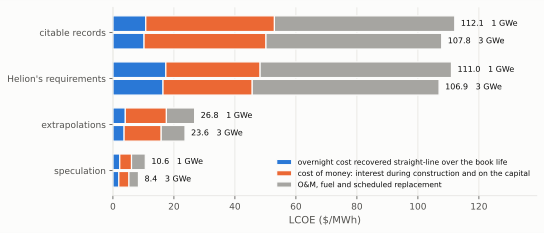
Figure 1: The four devices at 1 and 3 GWe, one machine per evidence grade, each bar split into the overnight cost recovered straight-line over the book life (blue), the cost of money, interest during construction and on the capital (orange), and O&M, fuel and scheduled replacement (grey). Cost of capital 7% real at the records and Helion devices, 5% at extrapolations, 3% at speculation; book life 60 years at the records device, 30 at Helion’s, 80 at extrapolations and speculation.
The two cheaper devices differ in kind. The extrapolation device changes what is bought, each entry a labeled step beyond a record with a physical argument behind it; the speculation device changes the prices and the ceilings, none with a mechanism behind it. The tornado below is drawn from the extrapolation device because its entries are the ones a measurement could confirm or refute; the anatomy after it is drawn from the speculation device because that is the floor.
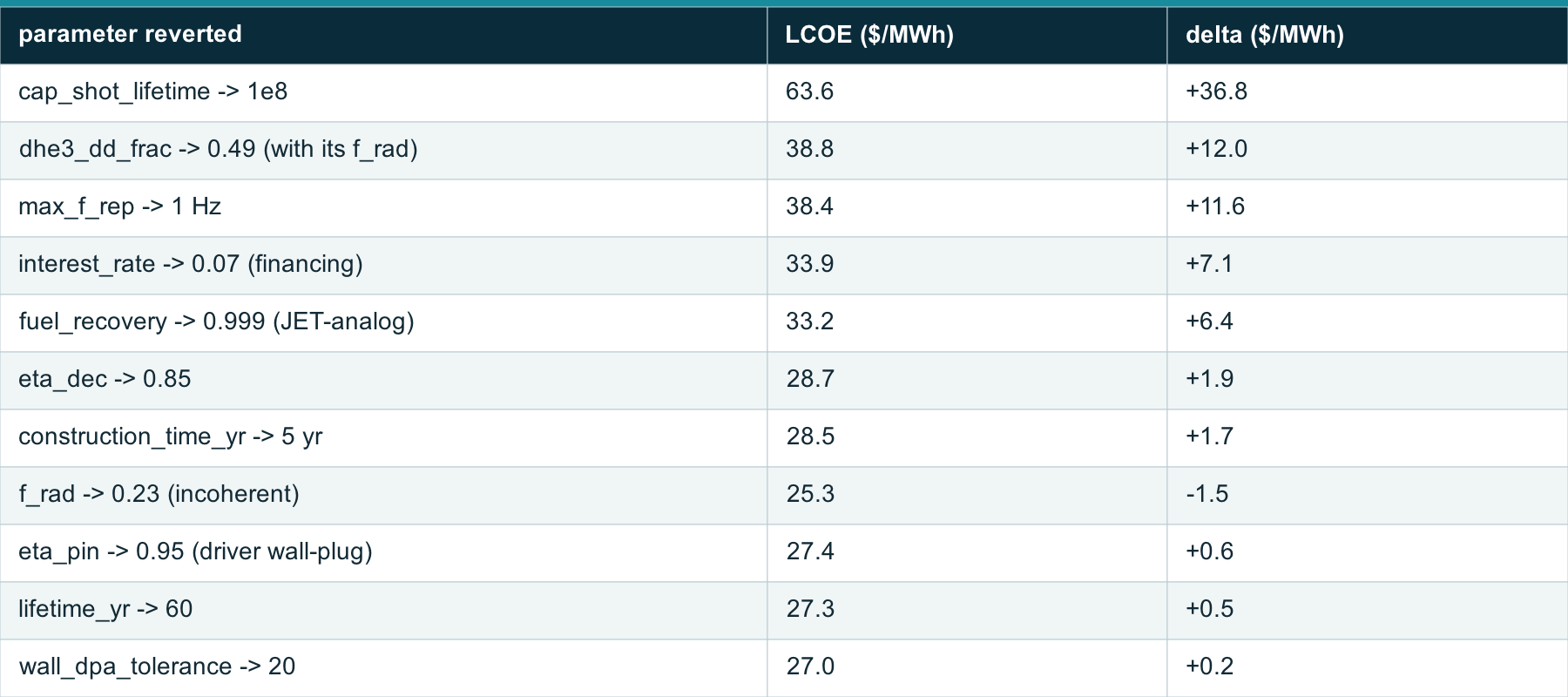
One-at-a-time reversion from the extrapolation device ranks the levers:
View the full table on 1cf.energy.
The capacitor cycle life dominates; the burn mix and the rep rate follow at a third of its weight; then come the cost of capital (the grey financing bar, 7.1 $/MWh), the fourth nine of fuel recovery (6.4 $/MWh, most of it the He-3 bought while the store builds up), the 3.25-year build (1.7 $/MWh) and, against the 60 years the records grade now holds, the 80-year book life (0.5 $/MWh). f_pdv and the shot are absent from the table: the extrapolation stack leaves f_pdv at the basis 0.80 under a cap that does not bind, and the shot’s record value is no plant. The conversion efficiencies, once capped as a composite, are worth little at the margin.
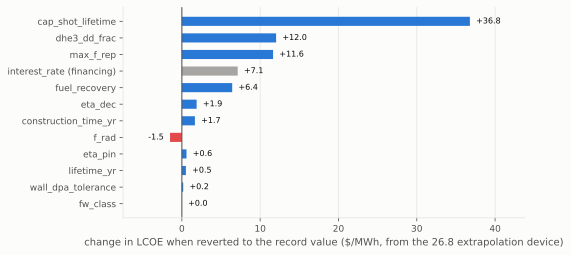
Figure 2: One-at-a-time reversion of each extrapolation entry to its record value, from the 26.8 $/MWh extrapolation device. Red bars are favorable reversions; the grey bar is the financing entry, every other bar is physics or engineering.
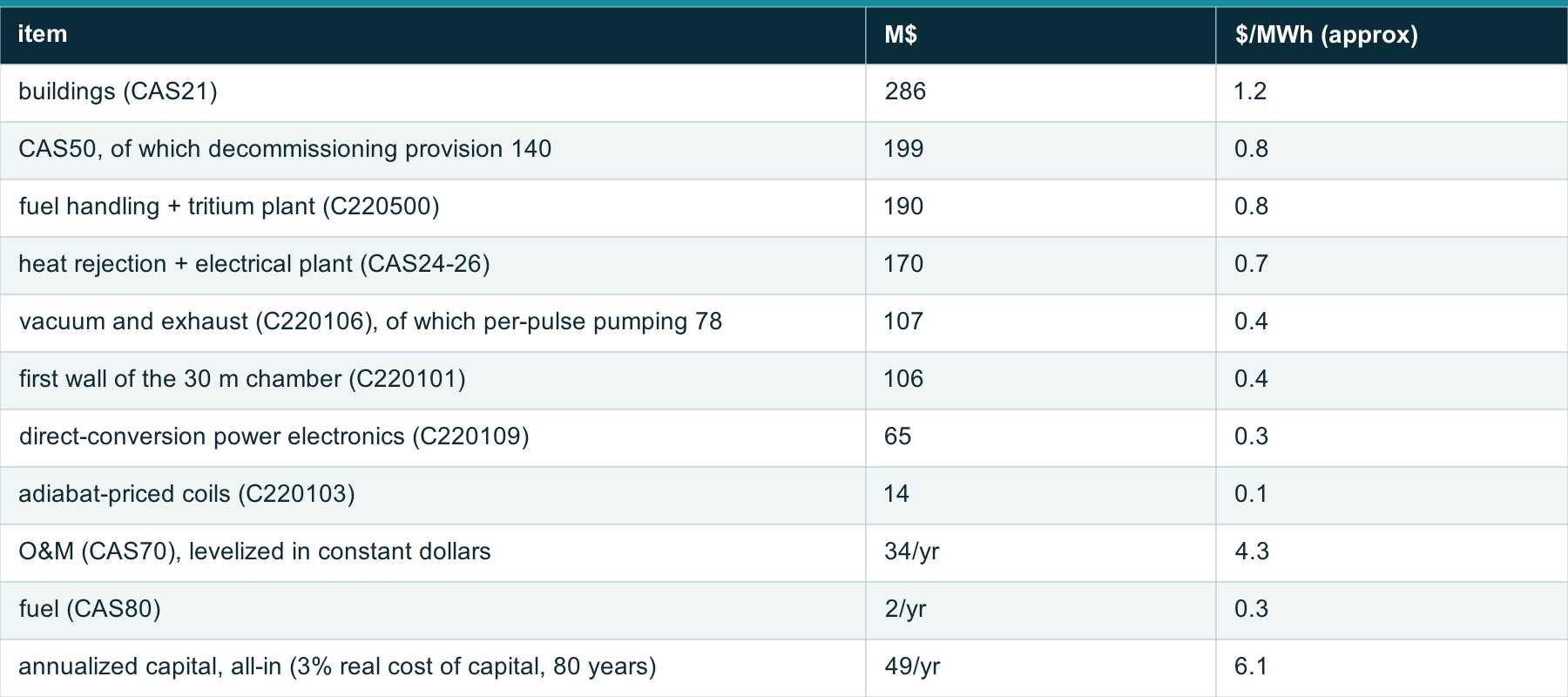
At the speculation device the capacitor-driver narrative is spent (the bank is 5 M$ of a 666 M$ reactor account) and the floor is carried by site and support infrastructure and by the fuel cycle (there is no turbine island; the heat-rejection and electrical-plant accounts below are not a steam cycle):
View the full table on 1cf.energy.
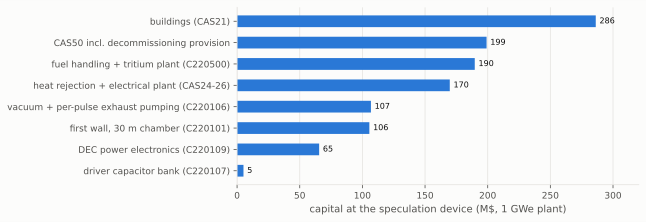
Figure 3: Capital accounts carrying the speculation device. The driver bank, the concept’s narrative centerpiece, is the smallest bar; site infrastructure and the fuel cycle dominate.
5. The He-3 fuel cycle is the load-bearing subsystem
The finding. The cycle rests on three things, and the ladder prices each: He-3 at a price no one has paid at tonne scale, or bred on site; a site inventory of about 1.4 tonnes of tritium, 350 times ITER’s authorization, held while it decays; and per-pulse fuel recovery at four nines, the fourth of which is worth 6 $/MWh at the extrapolation device and 49 at Helion’s own mix. A fourth condition is not a price but a fact about the pulse: the store works only if bred tritium does not burn before it is pumped out, which holds at Helion’s stated pulse and fails at the burn the granted shot needs.
The fuel cycle is the one in Helion’s patent [15], whose operating table also fixes the burn point: a plasma with He3/D = 0.158 at 70 keV and 22 T (Helion’s stated compression field of more than 15 T is consistent with that density through pressure balance), radiating 23% of its fusion power as bremsstrahlung and releasing 6% as neutrons. Slough [16], citing the same patent, restates that mix as the self-sustained cycle’s limit, He-3 at roughly 16% of the fuel, and puts the D-He3 gain at equal FRC conditions a factor of 240 below D-T’s, which is why the reactor he designs in that paper is D-T. The D-D reactions are what close the cycle. Half of them produce a He-3 atom directly (the prompt branch); the other half produce a triton (the tritium branch), which is pumped out with the exhaust after the pulse, separated, and stored on getter beds until it decays into He-3 (12.3 yr half-life). Almost none of the tritium burns before it is removed (dhe3_f_T = 0 in the basis). The plant therefore has no lithium anywhere, and its tritium plant is an exhaust-processing and storage plant.
5.1 The He-3 balance and the observed market
The tritium branch, half of the D-D events, produces 0.42 tritium nuclei per primary event at the D-rich mix, and each decays to He-3 on the 17.8 yr mean life of that 12.3 yr half-life. That He-3 is fuel for the reactor: it replaces purchased He-3 atom for atom, and from an empty store the replacement builds as 1 - e^(-t/17.8 yr), reaching the full 0.42 per event against the 1 - dd_frac the plant burns only at equilibrium. This work levelizes the credit over the book life at the grade’s rate; the prompt bred He-3 counts as extra burns, not as supply, and the store’s own capital, inventory and licensing are priced regardless (constraint 4).
A deuterium-rich plant therefore buys He-3 only until the store covers its need, about eight years, which takes its levelized purchase to a fraction of the perpetual one: 22% at the records device, whose 7% rate weights the build-up years most, 16% at extrapolations and 11% at speculation. Helion’s own mix breeds less than it burns and keeps buying, at 82%. Bought in perpetuity at the ledger price instead, He-3 would cost the four devices 35, 4.5, 7.1 and 1.4 $/MWh more; free, it would save them 9.7, 20.3, 1.4 and 0.2 at their own mixes, and it would change the mix (Section 7).
The price matters because no cheap He-3 exists. The DOE Isotope Program’s 2011 allocation was 600 $/L to federal users and 1,000 $/L to commercial users [17], 4.5 and 7.4 M$/kg, and prices have risen since. The 2024-2026 transactions sit at 19-22 M$/kg on gram-to-kilogram volumes, four to five times the 2011 allocation: spot near $2,500/L per the Edelgas Group [18], Interlune’s agreements with the DOE Isotope Program and Maybell Quantum “at today’s commercial market price”, and TAE’s unpriced lunar supply option from Black Moon. The 2 M$/kg this study charges sits below both, and the speculation entry, 0.5 M$/kg, nine times below the 2011 allocation.
At the 2011 allocation the extrapolation device reads 28.5 $/MWh at the D-rich mix and 67.6 at the 3:1 mix; at the commercial spot, 39.2 and 226. The deuterium-rich machine is nearly indifferent to the He-3 price, because it buys only during the build-up; the 3:1-mix machine is not. The credit is coupled to the burnup closure of Section 5.2, because the decay return exists only if the tritium survives the pulse.
One consequence: a kilogram of He-3 burned at the floor produces about $1.8M of electricity, but sold for $4.5M at the 2011 allocation and sells for $19-22M today, so an early breeding plant earns more selling He-3 into the thin cryogenics and quantum market than burning it, until fleet supply floods that market.
The store that self-supply implies is large. At the speculation device the module breeds tritium at half the D-D rate: 0.55 mg per shot, 56 kg/yr. The extrapolation stack on Helion’s chamber carries 211 MW of plant neutron power and breeds about 78 kg/yr. Store-for-decay fixes the equilibrium inventory at production rate times the 17.8 yr mean life: about 1.4 tonnes of tritium, which is 1.3e10 Ci, about 450 kW of continuous decay heat, roughly 350x ITER’s site authorization and 50x the world’s civilian tritium stock. The inventory is intrinsic to He-3 self-supply at this scale; shipping it to a central fuel facility relocates it (and can hold the reactor site near ITER-class inventory with weekly pickups) but cannot shrink it. This is why the ledger refuses the “near-zero licensing” claim alongside the fuel credit, holds O&M at its baseline, and treats the 200 M$ tritium-plant allowance as more likely low than high.
The alternative to self-supply is a dedicated deuterium breeder, a pure-D module of the same grade with its bred He-3 and tritium pumped out every pulse, priced per kilogram delivered as module ownership plus a throughput-sized tritium plant plus its net power at the device’s own LCOE (scripts/breeder_loop.py; the tables are in the ledger). It reads the ledger’s price back at the records grade, 2.0 M$/kg, cannot be reached at the Helion device (6.9 M$/kg), and charges about 0.7 M$/kg at extrapolations and 0.2 to 0.5 at speculation; since a self-supplying device buys He-3 only for its build-up, it moves the ladder little outside the Helion device, and it relocates the tritium inventory rather than shrinking it.
5.2 Fuel recovery and the burnup closure
Helion’s cycle depends on pumping the bred tritium out of the exhaust before it burns, so whether the shot and the fuel plan are compatible is a question about pulse length, not a modeling choice. The store-and-decay idealization (dhe3_f_T = 0: no bred triton burns in-plasma) is therefore a claim about pulse kinetics. A triton born mid-pulse sits in a deuterium-rich plasma at fusion temperature for the rest of the burn, and D-T reactivity is 27-87x D-D at 70-20 keV [19], so each unit of D burnup burns 14-43x as much of the bred tritium. The per-pulse deuterium burnup pins the integrated exposure x_DD = -ln(1 - f_D) = n_D ⟨σv⟩_DD tau, and averaging over triton births gives the thermalized-limit in-pulse tritium burn
f_T = 1 - (1 - e^-x)/x, x = (sv_DT / sv_DD) x_DD,whose only physics input is the reactivity ratio. Prompt orbit loss from the plasmoid, whose separatrix sits only a few ion gyroradii from the field null, is the one mechanism that can hold the burn below this floor; beam-target burn of the slowing triton can only add to it. This closure is enforced as coherence constraint 5: any quoted point whose dhe3_f_T sits materially below the floor is flagged as coherent only under prompt triton loss.
The basis is the patent’s burn point, n_D = 0.75e22 m^-3 at 70 keV, and Helion’s stated pulse, not the patent’s confinement time (0.10 to 0.16 s, three to four orders beyond any demonstrated FRC confinement, and the reason the shot is graded rather than priced). Over a full confinement period at that point the D burn would be 2.5-3.8% and a thermalized triton riding it would burn 28-38%, which is the patent’s own case for inter-pulse removal.
Over a sub-millisecond pulse the burnup is 1.2-2.5e-4 and the in-pulse tritium burn 0.2-0.3%, so dhe3_f_T = 0 satisfies its floor with two orders of margin. Figure 4 draws the closure against burn time. At the 0.3 to 0.7 s the design-basis shot needs under constraint 7, a thermalized triton burns 58 to 80% before removal, and at the speculation shot’s 1 to 3 s, 88 to 95%; the store-and-decay cycle and the granted shot are coherent together only under prompt triton loss, the branch the burnup axis of Figure 5 prices at high burnup.
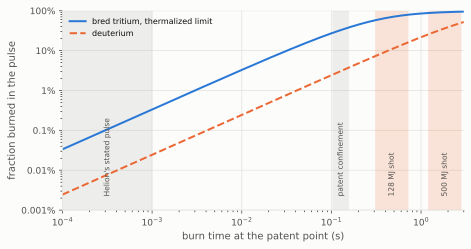
Figure 4: The burnup closure against burn time at the patent point (n_D 0.75e22 m^-3, 70 keV): the per-pulse deuterium burnup (dashed) and the in-pulse burn of a bred triton in the thermalized limit (solid). The bands mark Helion’s stated pulse, the patent’s own confinement time, and the burns the design-basis and speculation shots need under constraint 7 across x_s 0.5 to 0.85. The store-and-decay basis holds at the stated pulse; at the burn the granted shot needs, most bred tritium burns in the pulse unless it is promptly lost.
Fuel therefore resides in the machine of order a thousand pulses before burning, and the model carries the per-pulse pair burn_fraction = 1.2e-4 and burn_fraction_he3 = 4.1e-4 (He-3 burns 3.3x faster per pass), with species-resolved recycle losses in the fuel account. A recirculating nucleus faces the same race every pass, burn with probability bf (burn_fraction) or leak with probability 1 - fr (fuel_recovery), so its ultimate fate is the geometric series bf / (1 - fr (1 - bf)), set by the ratio of the two rates:

View the full table on 1cf.energy.
At the four-nines basis, 80% of the He-3 burns and 20% is lost, while deuterium splits nearly evenly between burning and leaking; at three nines the loop is primarily a fuel-disposal device, wasting 71% of its He-3, and at two nines nearly everything leaks. Tritium sees no geometric series at all: it is extracted to the store on its first pass, so separation loss hits it once, not compounded. With per-pulse reprocessing the unburned-fuel repurchase multiplier is 84x at per-pass recovery 0.99, 9.3x at 0.999, and 1.8x at 0.9999. A deuterium-rich plant is self-sufficient in He-3 at three nines, so the multiplier bites only on the He-3 bought while the store builds up and the fourth nine is worth 6 $/MWh at the extrapolation device (Section 4); at Helion’s mix, which breeds less than it burns, it is worth 49. Hertz-rate isotope separation and the tritium plant are the price of the store itself.
The JET figure behind the three-nines record is an analogy, not a per-pass measurement: campaign retention measures co-deposited wall inventory over many recycles, not single-transit loss, and none of the separation slip a per-pulse reprocessing plant adds [13].
Both species’ per-pass burn fractions derive from the same n tau, so the axis is swept coherently: burn_fraction_he3 scales with burn_fraction at the fixed 70 keV reactivity ratio (3.3x). Figure 5 shows the speculation device’s LCOE along that axis under both triton fates, at exhaust recovery 0.99, 0.999, and 0.9999. At the patent burn point the per-pulse fuel recovery sets the cost almost alone: 10.6 $/MWh at four nines, 12.2 at three, 27.0 at two.
Toward higher compression density the recovery requirement relaxes: above per-pulse burnup of about 1e-3 the three- and four-nines curves converge near 10.0-10.3 $/MWh on the prompt-loss branch. That branch is a floor on the fuel side rather than an operating point, because the same orbit loss that spares the tritium also removes the fusion protons, about four fifths of the charged fusion energy at the D-rich mix. The thermalized branch turns up past burnup 0.01 as the tritium burn grows (13-90%), so the triton-fate question reopens exactly where the recovery question closes. Per-pulse exhaust pumping is priced across the axis and peaks at the patent burn point (78 M$ per module at the floor: 8300 pumped particles per reaction).
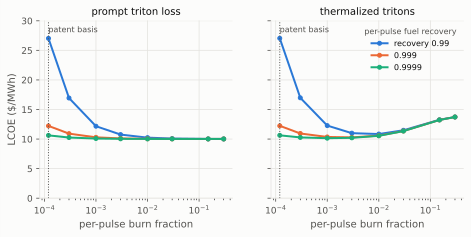
Figure 5: LCOE at the speculation device across the per-pulse burnup axis under the two triton fates and three exhaust-recovery grades; the patent-density basis (dotted) is the hardest point for fuel recovery.
5.3 Neutron damage and the unshieldable throat
The replacement rate of the wall, coils, and vessel shell follows from the D-T-equivalent neutron wall load and a dpa tolerance. The load counts 10 dpa per MW yr/m^2 in Fe-based structure, with the 2.45 MeV D-D flux folded at 0.4; the tolerance is taken at 20 dpa, the edge of the irradiation database for reduced-activation ferritic-martensitic (RAFM) steel, and at 50 dpa, the DEMO-class design target. The event carries both the wall and the close-coupled coils (106 + 14 M$ at the speculation device), since nothing 0.10 m behind the wall outlives it. At the patent basis the spectrum is pure 2.45 MeV D-D at a 14-MeV-equivalent load of 0.20 MW/m^2, and the replacement cost is modest (+0.3-1.2 $/MWh at 50-20 dpa). The damage story reopens only in the high-burnup counterfactuals: if the reactor-point density pushes per-pulse burnup toward the 0.1 regime with thermalized tritons, the all-in gap between prompt-loss and thermalized reaches 8-16 $/MWh, and on the extrapolation stack’s divertor-class wall (2.5 M$/m^2, at Helion’s chamber) thermalized high-burnup replacement is prohibitive (+52 to +134 $/MWh). Keeping the tritium out of the burn is therefore free insurance at the patent burn point and worth double digits off it.
Shielding cannot buy the machine out of this, because a pulsed inductive plant pays per pulse for every cubic meter of flux volume between coil and plasma: W = (B^2/2mu0) x annulus volume, recovered only at the composite efficiency. The 50 MJ driver at the 22 T basis field implies about 0.26 m^3 of compression-section flux volume; a 0.4 m shield under the compression coil multiplies the swept annulus by more than an order of magnitude, growing the store to several hundred MJ per pulse and dissipating tens of MJ per pulse at composite 0.90: order 100 MW or more of recirculating loss at the speculation rep rate. Shielding is affordable only where the guide field is low, far from the burn section, so the coils nearest the burn are sacrificial, ceramic-insulated, and on the wall-replacement schedule. The burn is also localized near the compression section, so the uniform-cylinder audit understates the local load; a localized audit would roughly double the damage costs.
The replacement schedule has a structural threshold. The wall, coils, and vessel shell are 155 of about 370 M$ of per-module reactor hardware; replacement of the wall-and-coil event (120 M$) outspends the module’s own capital service when its interval falls below about 10 years at the speculation grade’s 3% real cost of capital (5 years at 7%). At the patent basis (D-D spectrum, 0.20 MW/m^2 equivalent) the interval is about 10 to 25 years at 20 to 50 dpa: a capital asset at the design target, at the edge of one at the RAFM database edge. The consumable-core regime (1-3 year intervals, half the module’s value swapped near-annually) belongs to the high-burnup thermalized counterfactual, where the core becomes a swappable cartridge and the plant a manufacturing operation with a waste stream this study does not price.
6. The yield a shot can return, and what the circuit recovers of it
The finding. Helion’s public numbers cannot all be true at once: the shot Orion needs, the plasma conditions in the patent, and the stated millisecond pulse are mutually inconsistent. At that pulse the fusion energy a shot can return is a fraction of what the circuit loses in firing it, and the shot Orion needs implies a burn hundreds of times longer than Helion describes. That makes the disclosed design point incoherent, not the machine impossible: something Helion has not said publicly would have to close the gap, or the patent no longer describes the machine.
Every number in this work grants Helion’s shot. This section bounds what a shot can return from the plasma’s own energy and burn time, then sets out the two further bounds on what the circuit recovers of it, the share of the driver energy that thermalizes and the expansion ratio the chamber allows, beyond the composite cap of constraint 2 that stops the two conversion efficiencies from being counted twice. A three-shot sequence on Polaris would measure all three.
The yield bound. The plasma at peak compression holds a share chi of the delivered driver energy E_del (50 MJ per pulse): merging shock and compression work are the only heating, and chi is fixed by the FRC equilibrium as a function of the separatrix-to-coil radius ratio alone, chi(x_s) = 1.5 β̄ x_s² / (1.5 β̄ x_s² + 1 - x_s²), with β̄ = 1 - x_s²/2 [20]: 0.30, 0.52 and 0.71 at x_s = 0.5, 0.7 and 0.85. That energy sits at the energy density of a beta = 1 plasma, 1.5 B^2/2mu0, and burns at the fusion power density of the burn point, so
gain <= chi x burn time / breakeven time,with the breakeven time the ratio of those two densities, the fusion breakeven time of Lackner et al. [21]; the pulsed gain of Nicolas et al. [22], fusion energy over plasma energy, is the same ratio against their Lawson time.
What the bound reads at Helion’s numbers. The patent point is n_D 0.75e22 m^-3, He3/D 0.158, 70 keV and 22 T. At Bosch-Hale rates its breakeven time is 86 ms with thermalized electrons, and 3.7 times shorter if the electrons could be held at a tenth of the ion temperature. They cannot be held there: the ion-electron equilibration time at that density is about 1 ms, well inside the breakeven time [21]. Helion’s stated pulse is hundreds of microseconds to milliseconds [2], and against it the bound reads three ways. A 1 ms burn returns 0.2 to 0.4 MJ from the 50 MJ bank across x_s 0.5 to 0.85, against the 2.5 MJ the circuit loses per shot even at the ladder’s best inductive efficiency, eta_dec 0.95. The design-basis 128 MJ shot needs a burn of 0.3 to 0.7 s, three to seven hundred times the stated pulse; both scale inversely with the number of modules Orion turns out to be (Section 2). The speculation shot needs 1 to 3 s.
The bound also reproduces the co-founder’s own D-T design: Slough [16] quotes a gain of 9.1 on the FRC energy over a 2 to 5 ms transit at 34.8 T and 15 keV, and at that point’s breakeven time the same arithmetic gives a 3.4 ms burn. This is constraint 7, and it is why the shot is a graded claim rather than a shared basis; every point the scripts evaluate carries the burn time its shot implies at x_s 0.7. The same two papers bear on constraint 1: their independent reconstructions find Helion’s fusion-to-bremsstrahlung ratio 3.6 to 9 times too favorable [22] or about an order of magnitude [21], the provenance of the 0.05 radiated fraction that constraint 1 withdrew.
Driver thermalization. The same chi bounds the recovery of the driver energy itself. The thermalized share can only return through the same expansion channel as the fusion heat, at f_pdv, while the model recovers all of it at the flat inductive efficiency. The uncaptured loss is worth +1.4 to +3.3 $/MWh at the extrapolation device across the x_s span, under 0.1 $/MWh at the speculation device, and order +10 $/MWh at the low-gain Helion device; it is carried in the reconciliation bands.
The expansion-ratio bound. Constraint 6 caps f_pdv at the adiabatic-stroke bound 1 - (V_i/V_f)^(2/3), with V_i = E_del/(B^2/2mu0), about 0.26 m^3 at 50 MJ and 22 T. Applied per point: the extrapolation device’s 10 m x 1.5 m chamber caps f_pdv at 0.98, above its claimed 0.80, and the speculation device’s 30 m x 1.5 m chamber caps it at 0.989, just above the claimed 0.947. The large chamber buys expansion ratio, not merely wall area, and recovery cannot be improved without more chamber. About a fifth of the expansion work is axial, against the end-field gradient [23]; constraint 6 counts the whole volume stroke, as Helion’s own burn-cycle framework does, and whether the end circuits return that fifth is a design question the shot sequence below measures.
The cycle is Diesel-type with an Atkinson over-expansion (burn at roughly constant pressure, then expand further than the compression stroke), the framing of Helion’s own burn-cycle analysis [24], which quotes about 60% for a constant-pressure burn and above 90% for optimal cycles. Two published figures sit against it. Nicolas et al. [22], whom Helion’s FAQ cites for recovery “exceeding 95%”, give that number only as an ideal Carnot-form bound and set it aside on the thin-cycle argument. Slough [16], the co-founder whose patent supplies the fuel cycle, derives 40% as the most an ejected FRC can return in a flux-conserving expansion chamber, where it comes to rest holding 1.5 pV of thermal energy against the field it has compressed, and states that an FRC does not free-expand. That is his own recovery topology, not the discharged compression coil this work’s f_pdv assumes, so it is carried as a risk row rather than a cap: at f_pdv 0.4 the extrapolation device reads 44.2 $/MWh (+17.4) and the speculation device 14.8 (+4.2). There is no Carnot exemption in any of this: cycle form, the compression and expansion ratios, and the entropy of the deliberately irreversible merging set the efficiency, which is what the composite cap encodes.
Measurement protocol. A three-shot sequence on Polaris separates the whole chain: a vacuum shot measures eta_dec alone; a plasma no-burn shot returns eta_dec[(1 - chi) + chi f_pdv], so its deficit against vacuum measures chi(1 - f_pdv); a burning shot adds the fusion composite, and its yield reads constraint 7 directly. This single protocol prices the composite cap, the thermalization share, the shot, and (through the wall budget) the rep-rate ceiling; published excluded-flux radii pin chi per shot in the interim. It is Helion’s own stated proof point: its FAQ defines demonstrating electricity from fusion as showing that energy returned to a capacitor bank came from fusion-driven expansion “rather than only from ordinary inductive coupling in the circuit”.
7. What reaches $10/MWh, and what gets it there
The target is reached only as a park. Two controlled sweeps at the speculation stack (constant gain, constant wall loading, driver and chamber scaled with module power) separate module count from plant size. Module count at fixed plant size is nearly free: a park of 500 MWe modules reads 10.1 $/MWh against the single 1 GWe module’s 10.6 $/MWh (the adiabat-priced coils reward smaller compressed volumes; 250 MWe modules read 10.3), and even 50 MWe modules cost only four tenths of a dollar more (11.0), because buildings, supplementary capital, and balance of plant price plant totals; the only modularity tax is per-module fixed items, biting below about 100 MWe. Standalone plant size is expensive:

View the full table on 1cf.energy.
The standalone penalty is about 138 M$ of fixed site buildings calibrated on fission-class analogs, the P^0.5 staffing law of the Idaho National Laboratory sodium-fast-reactor basis [25], and the absence of any fleet-learning term on equipment, so this concept’s economics live in power parks, and the 50 MWe module of Helion’s gigafactory framing [4] is a manufacturing choice the model neither rewards nor punishes at park scale.
Within that park, the entry that carries the full speculation stack across is its financing: the 3 GWe park reads 8.4 $/MWh (10.6 at 1 GWe), and at the design-basis 7% real cost of capital the same machine reads 14.6 $/MWh (17.9 at 1 GWe), so the 3% real cost of capital, sovereign-class money with no mechanism behind it, is worth more than the whole distance to the target. No physics or engineering entry crosses it on its own, and the crossing needs the derived availability of 0.92 (at the model default of 0.85 the park reads 9.0 $/MWh and at 0.95 it reads 8.2, so it holds at any availability above the default) and Helion’s shot granted, as for every number here (the park’s 200 MJ pulses are a burn of half a second to a second at the patent point). It survives the wall-and-coil replacement, priced in Section 5.3 on top of the model’s figure: 0.4 $/MWh at the 50 dpa tolerance and 1.2 at the demonstrated 20 dpa take the park to 8.8 to 9.6 $/MWh.
He-3 at zero cost (6.5 $/MWh at 3 GWe): worth 1.9 $/MWh, and it changes the machine. The deuterium-rich park gains only 0.2 $/MWh, since it buys He-3 only while its store builds up; the design search re-run at zero price picks the He-3-rich mix (dd_frac 0.13) in 15 m chambers with no tritium plant, at 6.5 $/MWh.
Gas-class site and decommissioning analogs (about 2 $/MWh at 1 GWe, the whole of the buildings and CAS50 lines): defensible only for the 3:1-mix machine, which carries no tritium plant; the D-rich machine’s tonne-class tritium inventory argues the other way.
A real fleet-learning term on equipment, anchored beyond the fleet the nth-of-a-kind (NOAK) constants already assume, or it double counts: the only mechanism that rewards the mass-produced small-unit strategy at all.
None of these is in the evidence base at any grade.
8. Conclusions
Four devices on one architecture read 112.1, 111.0, 26.8 and 10.6 $/MWh at 1 GWe by evidence grade. Only the speculation park at 3 GWe, 8.4 $/MWh, is under the target, and a 3% real cost of capital rather than physics takes it there. The floor is carried by site infrastructure and the fuel cycle, not the driver bank, and at the extrapolation device the capacitor cycle life is the largest lever, worth three times the burn mix and the repetition rate.
Every number grants Helion’s shot, 128 MJ from a 50 MJ bank, which at the patent point needs a burn of 0.3 to 0.7 s against Helion’s stated pulse of a millisecond or less; over such a burn most bred tritium fuses before it can be removed, so the fuel cycle and the shot hold together only under prompt triton loss. The cheap machine is not the machine Helion describes: the design search picks a deuterium-rich mix at every grade because bred He-3 undercuts purchased He-3, and self-supply implies a tritium store of about 1.4 tonnes and a per-pass fuel recovery of three nines that no per-pass measurement supports.
Of the data Helion does not report (Section 2), the shot gates the whole plant, the recovery chain 2 to 17 $/MWh at the extrapolation grade, and the fuel-cycle data a few $/MWh at the deuterium-rich mix and tens at Helion’s; the capacitor cost at cycle life, a supplier’s datum, gates tens.
The speculation stack is jointly heroic: 0.1 $/J capacitors with 1e10-shot life contradict the derating physics that connects capacitor cost to life, the composite recovery sits at its theory optimum with zero margin, and the 500 MJ shot is a burn of seconds. The floor is conditional on the patent-basis compression field (a 10 T reactor point adds about 2 $/MWh, a 5 T point about 11) and on the discharged-coil recovery topology (Slough’s 40% ceiling adds 4.2 $/MWh at speculation and 17.4 at extrapolations); the neutron-damage costs are more likely low than high, and the one conservatism, no thermal bottoming, is worth -4.3 $/MWh at the extrapolation device.
The constructive reading: the floor, conditional on the shot, is low by any thermal-plant standard, the architecture of factory modules, park deployment and swappable cores fits the failure modes the physics imposes, and the data that would move the ladder from speculation to evidence, the shot first among them, are Polaris data.
For the direct-conversion corridor, this case identifies the requirements for shot yield, energy recovery, component life and helium-3 supply that a pulsed inductive plant would have to meet. Its conditional costs apply to the architecture and operating assumptions examined here. They do not establish the lowest achievable cost across the corridor. Other confinement and recovery arrangements remain to be assessed on the same whole-plant basis.
Reproducibility
The evidence ledger (Markdown) records the assumptions, sources, evidence grades and unresolved timing constraint behind this study. The public cost model is 1costingfe at commit 44434d9. The study-specific scripts, configuration files and source captures are held in the authors’ repository and are not yet public. The ledger and figures accompany this article, but they are not a complete reproduction package.
Conflict of interest
Tal Rubin and Damien Scott are co-founders of Borealis Fusion, a company developing proton-boron-11 fusion. Astera Institute is an investor in Borealis Fusion.
References
Rubin, T. (2026). 1costingfe: a bottom-up fusion power plant cost model. Repository at commit
44434d9.Helion Energy. Technology and FAQ pages (helionenergy.com/technology, /faq); the 20 April and 5 June 2026 FAQ captures are archived in
docs/sources/. Microsoft power purchase agreement announcement (2023).Kirtley, D., and Milroy, R. (2023). “Fundamental scaling of adiabatic compression of field reversed configuration thermonuclear fusion plasmas.” Journal of Fusion Energy 42, 30.
Kirtley, D. (2025). Interview on the Lex Fridman Podcast, episode 485, 17 November 2025, at 2:17:48.
Axios Pro (2026). “Helion hedges on how soon it expects to sell electricity from fusion,” 8 September 2026.
US DOE/NETL. Quality Guidelines for Energy System Studies: EPCM indirect-cost basis.
World Nuclear News (2025). “Zhangzhou unit 1 enters commercial operation,” 2 January 2025; and (2021) “First Hualong One begins commercial operation,” 30 January 2021.
Omoto, A. (2002). “Ten reactor years of ABWR experience.” Nuclear Engineering International, 3 May 2002.
IEA/NEA (2020). Projected Costs of Generating Electricity, 2020 edition.
Böhnlein, S., et al. (2026). “Too cheap to meter? A stochastic analysis of projected future fusion costs.” arXiv:2606.26536.
US DOE Water Power Technologies Office. Hydropower Basics.
Thea Energy (2025). “Overview of the Helios Design: A Practical Planar Coil Stellarator Fusion Power Plant.” arXiv:2512.08027.
Brezinsek, S., et al. (2013). “Fuel retention studies with the ITER-Like Wall in JET.” Nuclear Fusion 53, 083023.
Langtry, A., et al. (2025). “Affordable, manageable, practical Z-pinch driver (AMPS).” arXiv:2504.10680.
Helion Energy (Slough, J., Kirtley, D., and Pihl, C.). “Advanced fuel cycle and fusion reactors utilizing the same.” US 11,469,003 B2, granted 11 October 2022; published as US 2017/0011811.
Slough, J. (2025). “A compact fusion reactor based on the staged compression of a field reversed configuration.” Nuclear Fusion 65, 106019. doi:10.1088/1741-4326/ae034d.
Congressional Research Service (2011). “The Helium-3 Shortage: Supply, Demand, and Options for Congress,” R41419.
Edelgas Group (2024) helium-3 pricing, as reported in SpaceNews and Newsweek (2025); Interlune-DOE Isotope Program and Interlune-Maybell Quantum agreements (2025); TAE Technologies and Black Moon Energy Corporation helium-3 supply option (2026).
Bosch, H.-S., and Hale, G. M. (1992). “Improved formulas for fusion cross-sections and thermal reactivities.” Nuclear Fusion 32, 611.
Tuszewski, M. (1988). “Field reversed configurations.” Nuclear Fusion 28, 2033.
Lackner, K., Burhenn, R., Fietz, S., von Müller, A., and Ball, J. (2026). “Comments on the Paper ‘Fundamental Scaling of Adiabatic Compression of Field Reversed Configuration Thermonuclear Fusion Plasmas’.” Journal of Fusion Energy 45, 12.
Nicolas, T., Goupil, C., Herbert, E., and Ball, J. (2026). “The Challenge for Adiabatically Heated FRC Based D-3He Fusion.” Journal of Fusion Energy 45, 24.
Spencer, R. L., Tuszewski, M., and Linford, R. K. (1983). “Adiabatic compression of elongated field-reversed configurations.” Physics of Fluids 26, 1564.
Kirtley, D. (2024). “Fundamental theory of the direct magnetic energy recovery in a thermonuclear field reversed configuration system.” APS DPP 2024, abstract GO05.8; slide captures in
docs/sources/.Idaho National Laboratory. Advanced-reactor staffing studies.
Originally published at 1cf.energy.