

In Six Candidate Corridors to 1¢/kWh Fusion, we set out six premises for how fusion electricity might approach one cent per kilowatt-hour. The first studies examine selected plant designs, coproduct revenue and hypothetical deployment scenarios, with the conditions each would need. This post brings their findings together.
The target is 1 ¢/kWh ($10/MWh) in 2025 dollars at the plant gate, for a mature plant. The headline 1 GWe plant cases remain above it. Two speculative 3 GWe cases cross it, with demanding physics and engineering assumptions and a 3% real cost of capital. Coproduct revenue and repeated production offer other ways to approach the target, but answer different questions: what electricity price covers a plant’s costs after other sales, and what production and customer support a learning trajectory requires.
Each study covers a limited set of designs or scenarios. A result for one stellarator, mirror or pulsed plant does not settle the prospects of its whole corridor. The useful result is the set of assumptions that carries the cost reduction, the evidence behind those assumptions, and the tests that would change the conclusion.
What the six studies found
The most-mature corridor: large capital reductions still leave a substantial cost. The selected stellarator starts with the highest design-basis estimate in the comparison and falls from $227.5 to $25.9/MWh across the tiers. Much of the reduction comes from cheaper components, shorter construction, cheaper financing and longer plant life. Even that speculative case remains well above $10/MWh.
The pulsed-plant corridor: targets remain a recurring expense. In the two configurations studied, every shot consumes a target, so target fabrication cost and the rate of firing directly affect electricity cost. The speculative fiber/direct-drive and KrF cases reach $24.2 and $30.1/MWh respectively. Consumables, neutron protection, replacements and tritium handling all remain in the bill. Other plants also have marginal costs, but a manufactured target for every shot is a specific burden of these designs.
The direct-conversion corridor: efficient recovery leaves a demanding fuel cycle. The pulsed inductive D-He3 study reaches $26.8/MWh at 1 GWe with extrapolated assumptions and $10.6/MWh with speculative assumptions. Its lower costs depend on recovering energy efficiently, extending capacitor life and breeding helium-3 internally. Every priced case grants an unmeasured fusion shot, and the implied burn duration conflicts with parts of the assumed pulse schedule. Those conditions must be resolved before the costed machine is an established operating design.
The minimal-neutron corridor: fewer neutron-management systems reduce plant cost if the burn can be achieved. The p-B11 mirror omits a breeding blanket and tritium plant and uses a combined-cycle heat engine. Its extrapolation case reaches $26.1/MWh at 1 GWe. Stronger fields, higher plasma pressure, cheaper superconductors and favorable financing reduce the speculative result to $12.1/MWh. The calculation assumes 40 MW of drive, corresponding to fusion gain around 52 at 1 GWe and 150 at 3 GWe, without a confinement calculation establishing that performance. The plant-side savings depend on achieving that burn.
The byproduct-value corridor: other sales can support early plants. Gold reduces the design-basis plant’s required electricity price by about $21/MWh. That starting credit already assumes favorable discounting of a fourteen-year wait before sale and excludes enrichment-plant capital on the developer’s estimate that it is small. Mercury supply limits the scale of the opportunity. Heat and synthetic fuels offer other revenue, provided suitable buyers will pay enough to cover the extra equipment and electricity diverted to them. These credits reduce the electricity price needed to cover costs, not the cost of producing electricity itself.
The compact-learning corridor: early customers must sustain enough production. The supported scenario reaches $10/MWh for new orders in year 41, after about 64,500 completed 10 MWe units, or 645 GW of cumulative production. It assumes a $5/MWh fixed contribution and 25% learning on costs above it for almost sixteen doublings. The scenario’s above-wholesale cohorts require $23.1 billion of undiscounted lifetime premium commitments, not upfront capital or necessarily public subsidy. A working net-electricity product, support for early cohorts and demand for subsequent production remain conditions of the result. This scenario does not demonstrate a route to one cent within a decade.
Where each corridor stands
The chart compares selected plant and coproduct cases across their evidence tiers. The compact-learning study does not estimate a comparable bottom-up plant cost, so its production trajectory is considered separately.
Several tier settings are shared. The table shows the rates and other assumptions used by each study:

View the full table on 1cf.energy.
The five plant-cost studies also use technology-specific assumptions. The D-He3 and p-B11 studies derive availability from outage schedules, giving roughly 0.89 to 0.93, while the D-T studies step through fixed values from 0.85 to 0.98.
The evidence tiers differ in scope. The D-T studies grade plant engineering and financing while holding plasma performance at its design basis; the byproduct study also grades coproduct assumptions. The D-He3 and p-B11 studies additionally grade selected plasma parameters, such as beta and radiated fraction. The plotted cases retain the burn assumptions needed to calculate an LCOE for a net-electric plant, including at the records tier.
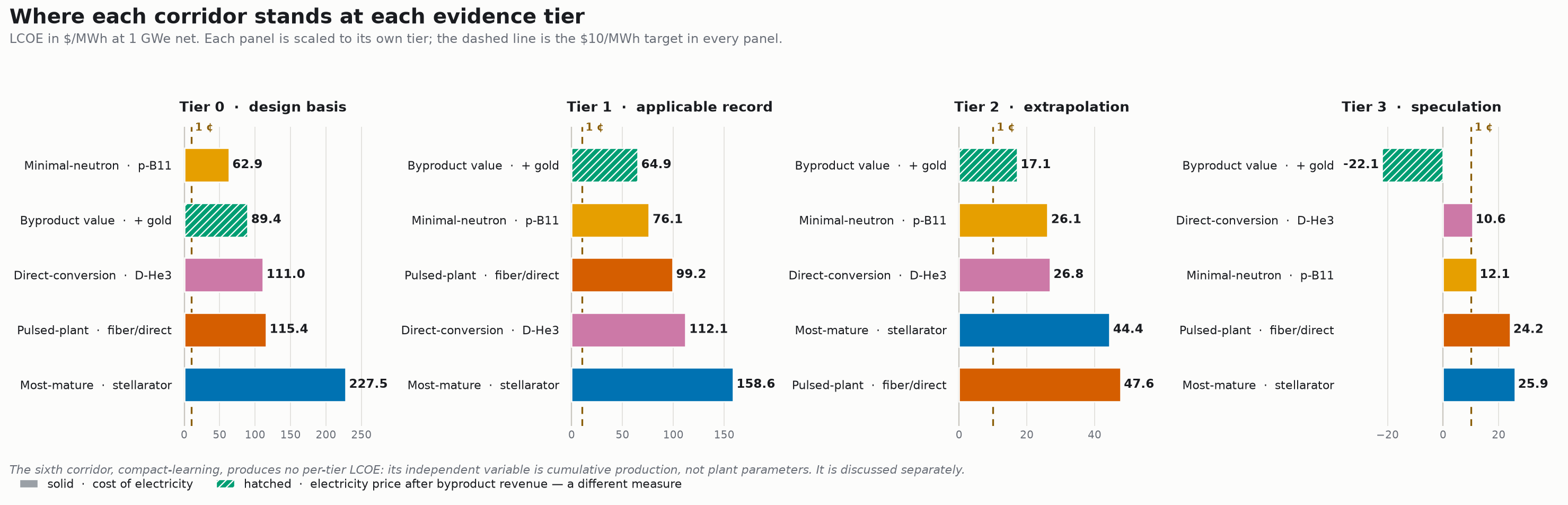
Figure 1. Quoted study results in $/MWh at 1 GWe net. Each panel has its own scale; the dashed line is $10/MWh in every panel. The pulsed representative is the fiber/direct-drive case. Solid bars show electricity-only cost; the hatched bar shows the required electricity price after gold revenue. A negative value means the assumed coproduct revenue covers more than the plant’s costs, not that generating electricity has a negative cost. Availability and evidence-tier scope differ as described above. The compact-learning scenario is separate.
Three findings follow from this comparison.
The p-B11 and D-He3 cases have the lowest quoted electricity-only costs. The p-B11 mirror is lowest through tier 2. At tier 3, the D-He3 case is lower. Its speculative assumptions include 90% composite energy recovery, capacitors costing $0.10/J and lasting 10¹⁰ shots, and an allowed repetition-rate ceiling of 10 Hz. That ceiling is not the selected device’s actual operating cadence. These rankings describe the priced cases under the assumptions described above.
The selected D-T cases remain in the tens of dollars per MWh. The speculative electricity-only results span $23.9 to $30.1/MWh: $23.9 for the byproduct study’s host plant before revenue credits, $24.2 for fiber/direct drive, $25.9 for the stellarator and $30.1 for KrF. The chart shows only the fiber/direct-drive pulsed representative. Cheaper magnets and drivers reduce large cost accounts, while neutron shielding, replacement outages, tritium handling and thermal conversion remain. These results describe the studied designs, not a universal D-T cost floor.
Plant size and financing decide whether the speculative low-neutron cases cross the target. The lowest headline 1 GWe tier result is D-He3 at $10.6/MWh. Its reconciliation range extends from $9.9 to $11.6/MWh, so the precise side of the threshold is not resolved. The quoted 3 GWe speculative cases reach $8.4/MWh for D-He3 and $9.4/MWh for p-B11 at 3% real cost of capital. At 7% real, they rise to $14.6 and $18.4/MWh respectively. Achieving a low plant cost and obtaining cheap financing are both required in these cases.
What carries the lower costs
The two low-neutron cases reduce cost in different ways. The p-B11 mirror uses a thermal cycle and avoids a breeding blanket and tritium plant. The optimized D-He3 plant removes the turbine but retains D-D neutrons, a large tritium inventory, wall-and-coil damage and scheduled replacement of its energy-recovery equipment.
Staffing and operating costs are model assumptions. At the design basis, the model assigns annual O&M of $54.9 million at 1 GWe for D-T, $27.5 million for D-He3 and $25.4 million for p-B11. These are fuel-specific staffing estimates, not demonstrated savings from operating plants. The D-T studies reduce O&M with the tiers and hold the tier-2 reduction of 55% at tier 3. The other two studies hold their baseline O&M, narrowing that gap.
Replacement costs depend on the design and assumed lifetime. The p-B11 speculative case prices no scheduled core replacements. That is an assumption about this plant, not evidence that all low-neutron plants avoid replacements. Capacitor life and the replacement of shot-cycled equipment are central to the D-He3 result.
The physics determines whether the proposed plant can exist. In the p-B11 case, the assumed drive and burn sustain a large thermal output. In the D-He3 case, the assumed yield, burn duration, pulse schedule and recovered energy must work together. Pricing the equipment does not establish those operating conditions.
Coproduct revenue offers a separate benefit. In the gold calculation, electricity output is held fixed and net gold revenue is credited against plant costs. The design-basis required electricity price falls from $110.5 to about $89.4/MWh. At tier 2, the gold credit takes it from $40.0 to $17.1/MWh, a reduction of $22.9/MWh. That is substantial, but smaller than the $70.5/MWh reduction from the host plant’s design basis to tier 2. Its value also depends on the gold price, mercury supply, transmutation performance and the financing of the long wait before sale.
Heat revenue can be combined with a thermal plant if a nearby customer needs the output. An illustrative combination with the tier-2 p-B11 case reduces its required electricity price by about 30%. It assumes 200 MWth of firm heat sold at $50/MWh-th, four hours of storage and $40/kW-year paid on incremental firm electrical capacity. This is a conditional integration example, not a demonstrated plant result or a benefit available at every site.
What follows
The studies identify specific work that could change the conclusions: demonstrate the required burn and energy recovery, establish component life at operating duty, and replace estimated costs with procurement evidence. The compact scenario adds a commercial test: identify customers and financing for the expensive early cohorts before relying on the learning from later production.
We hope researchers and developers will use and extend the public tools and code. Reproduction is incomplete for the two low-neutron studies: the shared cost model is public, but their study-specific scripts remain private, and only the D-He3 evidence ledger is currently public. The estimates should be revised as measurements, engineering designs and commercial evidence improve.
Conflict of interest
Damien Scott and Tal Rubin are co-founders of Borealis Fusion, a company developing proton-boron-11 fusion. Astera Institute is an investor in Borealis Fusion.
Originally published at 1cf.energy.