

AI can reduce the time and cost of some fusion research and engineering tasks. It is also beginning to help researchers find new mathematical solutions to problems relevant to fusion. The economic question is how these capabilities change the cost of delivered electricity.
AI’s use on fusion hardware predates the recent wave of large language models. A prominent early example was the collaboration between DeepMind and EPFL’s Swiss Plasma Center, published in Nature in February 2022. The team trained neural-network controllers through deep reinforcement learning in simulation, then used them on the TCV tokamak to control plasma position, current and shape. This was a specialized control system, not an LLM. It established that a learned controller could operate a real fusion experiment, while leaving its effect on commercial plant costs unmeasured. Degrave and colleagues, 2022.
We distinguish three possible effects: reaching a first-of-a-kind (FOAK) plant sooner, reducing costs through repeated production, and lowering the cost of mature, Nth-of-a-kind (NOAK) plants. The strongest evidence so far concerns specific research, design and control tasks. Their economic value depends on how they change the complete development program or plant. The evidence does not yet support a general percentage reduction in fusion electricity cost from AI.
The US Department of Energy has made AI-assisted fusion development a Genesis Mission science and technology challenge. The examples below help distinguish what is already demonstrated from what remains a hypothesis about plant economics.
Reaching the first plant sooner
Faster simulation and new theoretical results
Surrogate models approximate expensive calculations, allowing researchers to explore more alternatives within a given computing budget. A TGLF-based surrogate used in a STEP current-ramp study reduced a transport simulation from about two weeks on 60 processor cores to four hours on five. The study also reports reduced accuracy outside the training interval. This is a substantial improvement in a defined modeling task, with a validation boundary that needs to accompany the speedup. STEP study.
PhysicsX provides an adjacent example of reusing simulation data. Its automotive-aerodynamics study reports that adapting a pretrained model required about 80% fewer new simulations than training the same architecture from scratch at comparable accuracy in the studied cases. That comparison excludes the simulations used for pretraining. It shows how earlier modeling work can reduce the data needed for a new design study, while transfer to fusion components requires separate validation. PhysicsX technical study.
How much this changes a development schedule depends on what is holding up the next decision. Faster simulations can shorten scenario exploration when computing time is the constraint. Their contribution is smaller when a decision must wait for new experimental data, a component test or agreement on interfaces. A claim about time to FOAK therefore needs a schedule showing which tasks determine the completion date and how AI changes them.
Recent stellarator work adds a further possibility: AI can contribute to theoretical discovery. In a September 2026 preprint, Matt Landreman presents exact, non-axisymmetric magnetohydrodynamic equilibria with smooth pressure and nested toroidal magnetic surfaces. These address whether asymmetric magnetic fields can balance a non-uniform plasma pressure while preserving such surfaces. Landreman credits OpenAI’s GPT-6 Astra Pro with helping discover the solutions and draft parts of the paper, and states that he checked every equation manually. The explicit solutions also provide tests for numerical equilibrium codes. Landreman, 2026.
A separate preprint by Javier Gómez-Serrano, Lukas Liehr and Mitchell Taylor constructs counterexamples to Grad’s conjecture and supplies a Lean 4 proof certification. Its account of AI assistance distinguishes models used in developing the mathematics from later formalization and proofreading. Astra was used in the later stages of Lean verification and in final proofreading, and is explicitly not credited with the mathematical content. The authors directed the research and verification. Gómez-Serrano, Liehr and Taylor, 2026.
These are recent preprints about mathematical equilibria. They do not establish plasma stability, adequate confinement, practical coils or a lower plant cost. Their relevance is nevertheless direct: new analytic results can improve researchers’ understanding of allowable magnetic configurations and their ability to check design tools. Our economic interpretation is that this expands AI’s potential contribution to research. Translating it into cheaper electricity requires subsequent design and engineering results. We assign no cost reduction to these papers in the illustration below.
Design, engineering and experimental work
At the plant level, a useful design tool must connect plasma and component choices to the rest of the facility. Smaller magnets, for example, help economically only if the resulting configuration also satisfies shielding, structural, maintenance and performance requirements. Parametric models and automated analysis can make these interactions easier to examine. nTtau Digital’s NuPlant account describes this need for explicit interfaces between an evolving fusion core and conventional plant engineering. It is a development account, not evidence of a measured whole-plant cost reduction.
nTtau Digital also reports a more specific 2025 demonstration: a surrogate estimated tritium breeding, first-wall heating and cost almost instantly, compared with roughly 45 minutes for a Monte Carlo calculation, with approximately 15% reported accuracy loss. This is a company-reported comparison for preliminary design screening, where selected cases still require higher-fidelity calculations. NuPlant demonstration.
Zenithon reports a Z-pinch surrogate calculation taking less than eight milliseconds, compared with about five hours for the full magnetohydrodynamic simulation. Presented at an IAEA workshop in December 2025, the comparison illustrates the potential for faster plasma modeling, although the slides do not provide enough detail on hardware, validation coverage or training costs to establish how broadly the result applies. Zenithon presentation.
Fusionality is developing integrated measurement, simulation, control and data systems for fusion devices. Its founders, Federico Felici and Jonas Buchli, coauthored a 2024 study at EPFL and Google DeepMind in which dividing simulated training episodes into shorter segments reduced the time to train one plasma controller from about 40 hours to 10. The controller was subsequently tested on TCV. This predates Fusionality and is evidence of its founders’ research, rather than a benchmark of a company product or customer deployment. Tracey and colleagues, 2024, company announcement.
AI-specific gains also need to be separated from the benefits of established simulation, optimization and engineering automation. A workflow becoming digital does not establish how much additional value a learned model provides.
Within 1cFE, Reid Westwood developed an AI-assisted workflow for building and testing plant models in SysML v2. His exploratory-modeling study expanded a stellarator model from 55 to 199 calculations over 28 goals, then tested its extension to a second design. The work exposed missing constraints and incorrect assumptions as well as opportunities for further investigation. It demonstrates a way to develop and examine models, with expert review still essential before drawing conclusions about plant performance or cost.
Adjacent hardware offers examples with tangible outputs. LEAP71 reports that its Noyron computational engineering system generated a 5 kN rocket-thruster design in under two weeks from final specification to manufacturing handoff. The manufactured thruster subsequently hot-fired successfully on its first attempt. The interval does not include the full manufacturing and testing process, and this company-reported result is not a controlled comparison with a conventional development program. It does show why automated engineering deserves attention beyond drafting documents. LEAP71 technical account.
Singular Machines, a UKAEA spinout, provides another example of automated engineering. NCC reports that its platform generated a six-axis industrial-robot design in under a minute during a competition demonstration, compared with a stated typical two-week design process. The reported interval concerns design generation, with the comparison incompletely specified. Industrial validation and the effect on complete project schedules remain to be established. NCC account, UKAEA announcement.
Experimental design offers another mechanism. At OMEGA, researchers used a statistical model informed by experiments and simulations to select laser-fusion implosion designs, reporting a threefold increase in neutron yield. That is evidence that data-guided design can improve an experimental outcome. It does not establish a threefold reduction in development time or a corresponding gain in power-plant economics. Gopalaswamy and colleagues, 2019.
For magnets, blankets, divertors and other components, the practical opportunity is to obtain the information needed for a design decision from fewer test articles or a better sequence of tests. The measurement should be the time and expenditure required to reach a specified, verified performance level. A larger number of proposed designs is useful only when the team can evaluate them well enough to choose and qualify an improvement.
Construction and commissioning
Scheduling tools can help examine construction sequences, identify resource conflicts and respond to delays. A shorter construction period can reduce interest during construction and bring revenue forward. The effect depends on the expenditure schedule, financing terms and which activities can actually move. We should not apply a generic AI discount to the entire construction period.
Digital plant models can also help teams test control logic, interfaces and operating procedures before commissioning. Their value depends on how well they represent the equipment that is built. Unmodeled interactions and first-article defects still have to be found and corrected in hardware. Evidence from an individual workflow should therefore support a claim about that workflow until project-level schedule savings are measured.
Improving costs through repeated production
Our publication, Material Multipliers and Learning Curves, distinguishes a lower starting cost from a faster cost reduction as cumulative production grows. The same distinction applies to AI.
Manufacturing yield and process control. Models can identify process deviations, help diagnose defects and support adjustments that reduce scrap or rework. NIST-associated research has demonstrated learned representations of melt-pool images for anomaly detection in additive manufacturing. That supports a process-monitoring capability. The economic result still requires evidence of fewer rejected parts, lower inspection costs or higher qualified throughput in the relevant production process. Fathizadan and colleagues, 2021.
If such a tool improves yield before the first fusion component is delivered, it can reduce the starting cost. If it allows a manufacturer to improve yield more rapidly as experience accumulates, it could change the learning rate. Demonstrating the latter requires comparable cost and production histories that account for equipment investment, product changes and other improvements.
Fleet learning. Operating data can improve failure diagnosis, maintenance planning and component-lifetime estimates. Sharing those results across comparable units could make an improvement available to more plants sooner. This depends on compatible measurements, records of the actual equipment configuration, and rights to use the data. A collection of proprietary datasets that cannot be combined would restrict that benefit.
Some fleet savings have a different cause. Shared specialist crews, monitoring centers and spare-parts inventories can reduce costs through scale even without AI. An analysis should credit AI only with the additional improvement it enables in those arrangements.
Design stability. Repeated production benefits from stable interfaces, comparable parts and controlled changes. That does not require freezing every detail indefinitely. It does require a way to establish that a proposed improvement justifies its testing, tooling and qualification costs, and that learning remains transferable between versions. Cheap design generation could help find better changes. It could also encourage frequent redesign that destroys useful repetition.
AI may help a team extract more useful information from a small number of experiments or units. Whether that produces faster cost reduction must be measured. Early customers, financing and supplier commitments must also support enough production for learning to continue.
Lowering the cost of mature plants
Some improvements could change the engineering requirements and recurring costs that remain after production has matured. These are candidates for lowering a cost floor. They should be evaluated component by component, with the effect on the rest of the plant included.
Recovering design margins. Better predictions and operating evidence may show that a component can meet its requirements with less material, fewer diagnostics or a different maintenance interval. Shielding illustrates the potential and the constraint. A thinner shield could permit a smaller magnet assembly and building, but it could also shorten magnet life or increase replacement and protection requirements. The saving is established by the complete design change and its qualification. AI’s additional contribution must be measured against the margin recovery expected from ordinary engineering experience.
Materials and component life. Machine-learned interatomic potentials can extend the scale of radiation-damage simulations. A 2023 tungsten study demonstrated simulations with millions of atoms over hundreds of picoseconds using a learned potential. That is progress in modeling primary damage, rather than a qualified reactor material with a demonstrated service life. Liu and colleagues, 2023.
DuctGPT addresses another materials task: screening refractory alloy compositions for ductility. Its published study screened more than 1,000 compositions, including tungsten-rich alloys, and compared predictions with experimental data. This can help select candidates for testing and investigate materials that are easier to manufacture, while their behavior and lifetime under fusion conditions still need to be established. DuctGPT study, Ames National Laboratory account.
AI may also help laboratories interpret experiments fast enough to make better use of their equipment. Periodic Labs reports deploying Neon to analyze X-ray diffraction measurements from its materials experiments. This addresses identifying what an experiment produced. The company is extending the approach toward selecting experiments and synthesis procedures, but has not established a corresponding increase in qualified-material discovery or a reduction in fusion costs. Periodic Labs technical account.
If AI-assisted research produces a material with better performance under the relevant neutron spectrum, temperature and stress, the economic effects could include longer component life, fewer replacements and less downtime. These gains must be weighed against manufacturing cost, inspection requirements and the time needed to qualify the material. Screening a promising candidate and establishing those properties are distinct achievements.
Power consumed by the plant. Better control or component design could reduce the electricity required for heating, current drive, cooling and other plant services. The benefit has to be calculated using the plant’s full power balance. A change that saves auxiliary power but reduces fusion output may not increase electricity sold. Comparisons must also hold the output boundary consistent: gross generation and net electricity delivered are different quantities.
Operations and maintenance. Predictive maintenance and better sequencing of replacement work could reduce both operating expenditure and downtime. These effects are connected. The same assumptions about component life, replacement frequency and campaign duration must be used in both calculations. Remote monitoring and automation may reduce some staffing requirements, but the resulting plant still needs credible maintenance, fault response and supervision arrangements. A fully unattended plant is not necessary to justify useful improvements in these tasks.
The opportunities differ by architecture. Tokamak control improvements, stellarator equilibrium methods and laser-target manufacturing tools address different problems. Evidence from one should not become an identical discount across every fusion concept.
What still constrains the outcome
Physical requirements and qualification
AI can help researchers discover solutions permitted by physical laws and revise assumptions about what is achievable. The new equilibrium papers are an example of why a conjecture should not be treated as a physical prohibition. But improved analysis does not remove the need to establish stability, heat removal, material lifetime and the energy balance of a working plant.
For a thermal power cycle, temperatures constrain conversion efficiency. Irradiated components still require suitable handling and maintenance arrangements. Software can improve designs and decisions within these constraints. The engineering evidence determines how far those improvements can go.
Demand, supply chains and workforce
Suppliers need a credible commercial reason to add capacity and qualify processes. Developers need financeable equipment and construction plans. Early customers need confidence in delivery and performance. AI may improve forecasts, training, documentation and production planning, but it does not itself create an order book or commit investment.
Offtake agreements, procurement and other demand support can help establish that commercial basis. Whether they are justified depends on what has been demonstrated and what further production is expected to teach. A proposed learning curve is incomplete without an account of who will pay for the early plants and components.
Usable data and reliable checks
In its 2026 fusion data stocktake, DeepMind describes a gap between the large volume of data generated by fusion experiments and the portion that is validated, documented and accessible for reuse. JET illustrates the problem: valuable measurements and operational knowledge do not automatically form a reusable training dataset. Access and commercial-use rights are part of the constraint. DeepMind stocktake.
The data requirement differs by task. A plasma-control model may need representative measurements from the device it controls. A surrogate needs adequate coverage of the parameter range in which it will be used. A model helping with an analytic derivation can instead produce a result that a researcher checks mathematically. The common requirement is a reliable way to distinguish a useful answer from a plausible but incorrect one.
For plant engineering, that means maintaining the link between a model, its assumptions, the equipment configuration and the evidence used to validate it. Data preparation and model maintenance are recurring work that should appear in the cost of adoption.
Control, assurance and responsibility
AI-based control is already an experimental reality. Reinforcement learning has been used for magnetic control on TCV and to avoid tearing instabilities on DIII-D. These demonstrate specific control capabilities under experimental conditions. They do not establish a commercial plant’s availability or its safety case. TCV study, DIII-D study.
It helps to distinguish three choices: a model that advises an operator, a fixed model that commands equipment within defined limits, and a system that changes its model during operation. Autonomy and online learning are separate questions. Each requires evidence appropriate to its role and possible failures.
Other regulated applications show that the answer need not be a blanket prohibition. FDA has authorized autonomous diabetic-retinopathy screening, and its 2025 guidance describes predetermined change-control plans that can include bounded automatic updates. Neither establishes a fusion licensing precedent. They illustrate why the permitted function, validation and change process need to be specified. FDA authorization, FDA guidance.
For fusion cost estimates, we would require an operating envelope, protective systems, validation evidence and an accepted approach to updates before assigning benefits to a safety-relevant control function. That is our assessment criterion. There is no basis here for a universal assumption that all AI must remain advisory, or for turning that assumption into a numerical cap on capacity factor.
What the plant-cost calculation can tell us
The comparison needs the same reactor architecture, plant size, deployment stage, financing assumptions and performance requirements with and without the proposed AI contribution. A NOAK baseline should already include the improvements expected from conventional engineering and manufacturing experience. AI may bring those improvements forward, make them larger, or enable different ones. These effects need separate accounting.
Our exploratory calculator uses 1costingFE to examine a hypothetical mature D-T tokamak delivering approximately 1 GWe net at the plant gate. The baseline produces electricity at 10.89¢/kWh. Moving all five levers to the midpoint of the console’s lower-change band gives 9.20¢/kWh. Moving them to the midpoint of its qualification-dependent band gives 6.77¢/kWh.
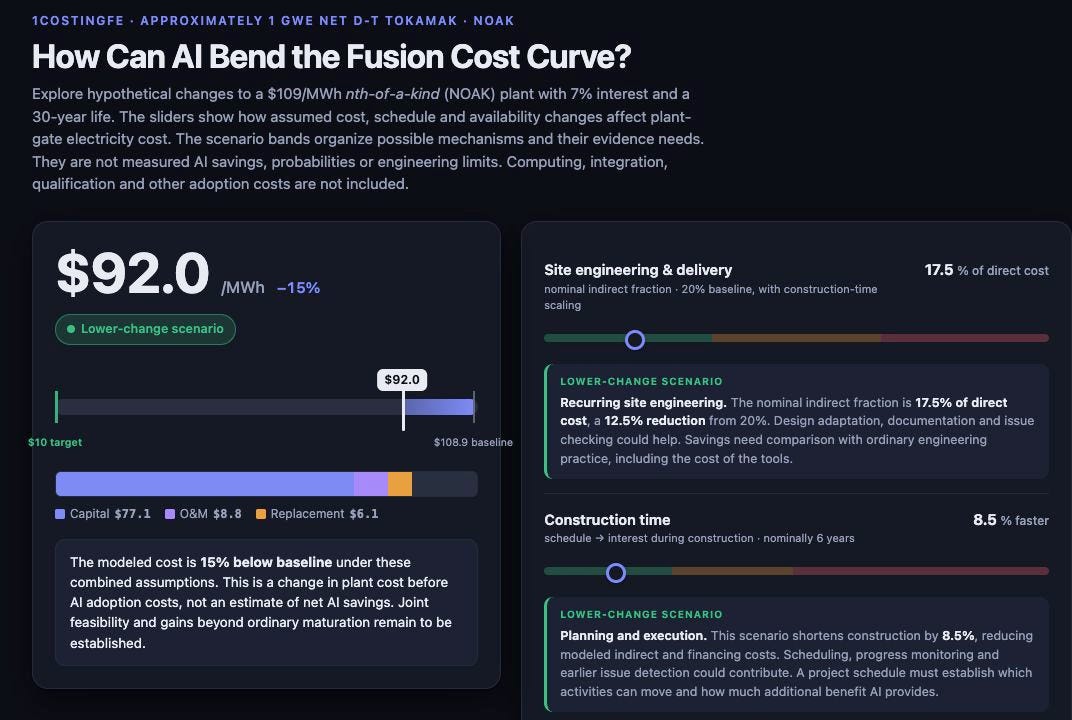
The AI Lever Console at the lower-change midpoint: 9.20¢/kWh before AI adoption costs. These are assumed plant improvements, not measured AI savings. Explore all five levers in the interactive console.
The reproduction package records the model version, baseline inputs and mapping from each lever to the plant calculation. The rebuilt surrogate agrees with the full model to about 0.03% at sampled validation points. That agreement checks the numerical implementation. It does not validate the plant assumptions or establish savings attributable to AI.
These are conditional cost scenarios. They exclude AI adoption costs and do not establish that the proposed improvements are achievable together or additional to ordinary engineering progress. Even the lowest of these three cases remains well above 1¢/kWh. For this illustrative tokamak, the assumed improvements reduce costs substantially while leaving a large gap to the target.
To make a numerical claim reviewable, each mechanism should enter a named plant input:
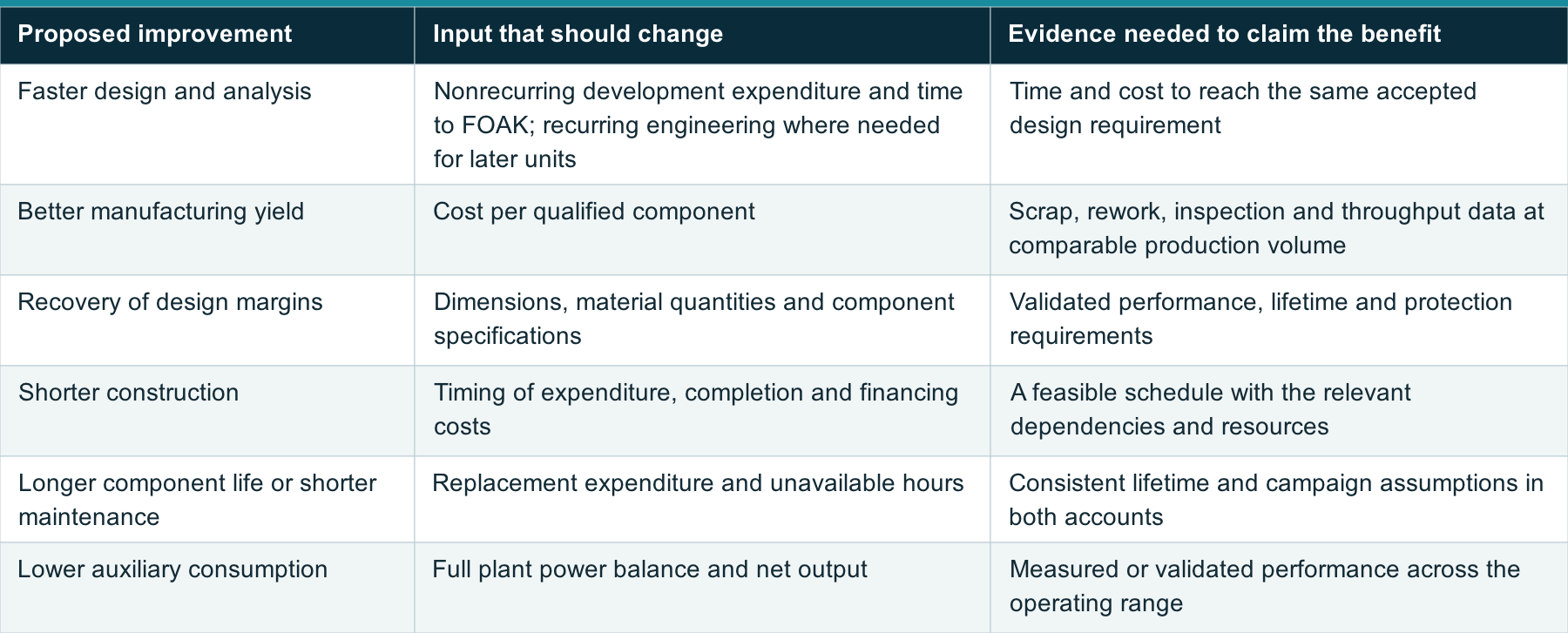
View the full table on 1cf.energy.
These changes interact. Lower capital expenditure reduces the interest that can be saved by shortening construction. Longer component life can reduce both replacement expenditure and downtime, while increasing the purchase price of the component. Savings must be recalculated through a consistent plant model, with common assumptions used wherever the same physical change appears. A one-time development saving affects later plants’ electricity costs only through an explicit allocation or financing assumption.
Prospective adoption costs belong in the comparison: computing, software, data preparation, integration, validation, training and maintenance. Historical research expenditure can be outside a plant-level LCOE boundary if that boundary is explicit. Costs passed through equipment or service suppliers remain relevant even when the plant does not purchase an AI system directly.
The evidence categories also need to be specific. A mechanism demonstrated in another industry establishes that it can work in that setting. It does not make the same percentage saving a demonstrated fusion result. Other improvements depend on component qualification, and some require a new physical capability that has not been demonstrated. These categories identify what remains to be established. They do not supply probabilities.
Several benefits also depend on common conditions, including data access, qualified equipment, stable interfaces and deployment. Failure to meet one condition can limit several benefits at once. An uncertainty analysis should include those dependencies, implementation costs and cases with no net saving. Independent draws from benefit-only assumptions cannot support a claim about the most likely net effect of AI adoption.
What we would measure next
The most useful next evidence connects a technical improvement to an accepted design or operating change. For research, measure the time and expenditure needed to obtain a checked result or resolve a defined uncertainty. For manufacturing, measure cost per qualified component at a stated volume. For plant operation, measure the change in net electricity delivered, replacement expenditure and unavailable hours, including the cost of the tools used.
The recent stellarator results strengthen the case that AI can contribute to the underlying research as well as to faster analysis. Experimental control and data-guided optimization provide further reasons to expect practical benefits. The scale of the economic contribution remains an empirical question.
AI could make fusion development faster, improve the value of each manufacturing run and support better plant designs. A credible cost claim must show which of these effects occurred, what it cost to achieve, and how it changes the plant. That is the evidence needed to decide whether AI is bringing an affordable fusion plant closer and whether it changes the eventual cost of its electricity.
Conflict of interest
Damien Scott is a co-founder of Borealis Fusion, a company developing proton-boron-11 fusion. Astera Institute is an investor in Borealis Fusion.
Sources and reproducibility
Sources are linked at the relevant claims. The two September 2026 equilibrium papers are cited as preprints. Their reported verification procedures are described above; this article does not independently certify their proofs.
The reproduction package contains the inputs, model version, lever definitions and numerical checks used here. Adoption costs and shared dependencies remain outside the calculation. No cost reduction is assigned to the recent equilibrium papers.
Originally published at 1cf.energy.